
England’s World Cup run ended in Atlanta after Thomas Tuchel’s late tactical retreat and contested selections left the side exposed, allowing Argentina — led by Lionel Messi’s presence — to seize control. The loss highlights an immediate managerial misstep and longer-term structural flaws: a shortage of elite, possession-controlling midfielders and an FA culture that has tried quick fixes instead of building coaching continuity.
England exit World Cup as tactical gamble backfires in Atlanta
England’s bid for global silverware collapsed in the semifinal after a period of late-game defensive substitution and collective paralysis.
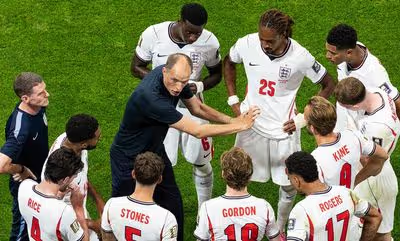
Thomas Tuchel’s switch to a deep back five between the 72nd and 92nd minutes surrendered territory and tempo, inviting relentless pressure from Argentina and effectively neutralising England’s attacking outlets, including Harry Kane.
How the game turned
Tuchel’s change felt reactive rather than corrective. With the team leading earlier, England retreated instead of consolidating possession and control. Argentina — aided by the game-management and individual class that come with players used to high-pressure knockout moments — seized the initiative and dominated the final half-hour.
The crucial phase was not a single failure but a collapse of nerve: the team dropped deep, lost its shape, and stopped asking questions of the opposition. England’s attempts to stem the tide became increasingly defensive and fear-driven, and the lack of a midfield hub to steady the match became painfully obvious.
Tuchel under the microscope — tactical errors and selection questions
Tuchel’s overall tournament work had promise: England beat the hosts and progressed to the semis. But the Atlanta match amplified three weaknesses in his approach — late-game risk management, in-game adaptation, and some selective squad choices that left tactical flexibility limited.
Switching to six defenders felt like an attempt to cling on, not to win. It worked against less probing opponents but was inadequate against a team that could exploit the smallest pocket of space. That decision will dominate headlines, and rightly so, because it turned a position of control into one of survival.
Was the squad the problem?
The squad largely performed across the tournament, with fringe players stepping up at times. Criticism of selection is a comfortable narrative, but it risks simplifying a more systemic issue: the team’s makeup reduced options in moments when a controlling, calming midfield presence was needed most.
Structural issues: midfield, culture and the FA’s short-timed fixes
The match exposed a longstanding England deficiency — the absence of a true elite controlling midfielder who can dictate tempo under knockout pressure. England has repeatedly lost tight games where midfield craft and game intelligence were decisive (recalls of Croatia 2018 and Italy 2021 are instructive).
More broadly, this failure is embroidered into decades of choices: a Premier League that is an international talent market, an academy system producing attractive athletes but not always the cerebral technicians required at the highest international level, and an FA approach that has at times sought rapid solutions rather than deep cultural construction. Hiring a high-profile club manager as a short-term fix was always a bandage, not a cure.
Why this matters — beyond one match
This defeat is both immediate disappointment and a diagnostic moment. On the surface, it will be catalogued as another English collapse. Beneath that, it reveals what clubs and the national setup must address: coaching pipelines, player development geared to game intelligence, and building midfield profiles designed for knockout football.
For Tuchel personally, the loss stains an otherwise impressive adaptation to international football. He demonstrated tactical acumen across the tournament but failed at the decisive moment. His overall stock remains substantial, but the FA must now decide whether to double down on continuity or return to the search for a different architect.
What could come next
Expect urgent internal review rather than public panic. Short-term fixes are possible but insufficient; meaningful progress will require a patient rebuild of coaching philosophies and talent pathways. England are closer to their goals than a decade ago, but the structural gaps exposed in Atlanta must be plugged before another tournament arrives.
England’s footballing identity — how it trains, selects and trusts players in crunch moments — remains the conversation. Atlanta was a painful reminder that managerial decisions matter, but so does the scaffolding that delivers the players who can handle them.
 The Guardian