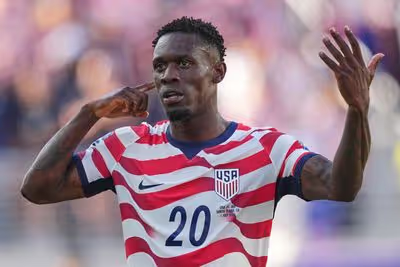
FIFA’s disciplinary committee suspended Folarin Balogun’s one-match World Cup ban — while fining him $40,000 and leaving the red card formally in place — sparking a sharp public row with UEFA and renewed scrutiny after US President Donald Trump phoned FIFA President Gianni Infantino. The episode raises urgent questions about consistency, governance and the autonomy of football’s judicial system.
FIFA suspends Balogun ban amid public row with UEFA
FIFA’s Disciplinary Committee has imposed a $40,000 fine on USA striker Folarin Balogun for a red-card incident described as “serious foul play” against Bosnia, but crucially has suspended the automatic one-match ban for a probationary period of one year. The effect: the red card stands on record, the fine is payable (with U.S. Soccer jointly liable for half), yet Balogun was cleared to play in the World Cup last-16 tie against Belgium.
What FIFA actually decided
FIFA invoked a provision of the FIFA Disciplinary Code allowing it to suspend the implementation of an automatic match suspension and instead place the sanction on probation. The committee says it weighed the incident’s “specific circumstances and evidence” and applied Article 27-style measures previously used in other cases, arguing this approach is a balanced disciplinary tool rather than an overturning of an on-field decision.
UEFA’s criticism and FIFA’s rebuttal
UEFA publicly criticised the decision, accusing FIFA of “crossing a red line” in handling the case. FIFA pushed back, noting that the practice of overturning or altering red-card consequences is not unprecedented among top-tier European leagues and that the committee did not void the sending-off itself. The governing-body clash has exposed differing interpretations of disciplinary norms between football’s global and continental institutions.
Political interference? The Trump factor
FIFA President Gianni Infantino confirmed he received a call from US President Donald Trump on the matter and described his interactions with heads of state as routine. Infantino emphasised the independence of FIFA’s judicial bodies, saying decisions are taken by autonomous committees under the FIFA Disciplinary Code — even as he acknowledged sometimes disagreeing with their outcomes.
Why this matters: governance, consistency and precedent
The dispute matters beyond Balogun’s availability for a single match. It highlights tensions in football governance: which bodies set consistent disciplinary standards, how much latitude independent committees have to temper punishments, and how public or political pressure can influence perception of impartiality. By suspending a ban rather than overturning a red card, FIFA is signalling a willingness to use probationary measures to manage sanctions — a tool that can be justified on fairness grounds but will invite scrutiny if applied unevenly.
Implications for players and federations
For players and national federations, this decision establishes that fines plus probationary suspensions are viable outcomes after serious on-field incidents — not just outright bans. That can benefit federations that want key players available for major fixtures, but it also raises fairness concerns for teams and players expecting uniform application of rules across competitions.
Precedent and potential fallout
FIFA pointed to similar uses of disciplinary discretion in past cases, including national-team contexts and World Cup qualifiers. Still, the public clash with UEFA could prompt tighter, clearer guidance on how and when probationary measures are deployed — otherwise the governance rift may deepen. Expect UEFA to press for firmer alignment on disciplinary appeals and for stakeholders to watch how FIFA applies probation in future high-profile incidents.
What happens next
Technically, Balogun’s dormant one-match suspension will be activated only if he commits another offence of similar nature within the one-year probationary window. Practically, the case may accelerate calls for uniformity between FIFA and continental confederations on appeals and sanctioning criteria. Transparency about the reasoning behind disciplinary adjustments will be the key test for FIFA’s claim of independent, consistent adjudication.
Bottom line
The episode is a reminder that disciplinary decisions at the top level of football are as much about optics and governance as they are about the incident itself.
Mbappé condemns Paraguayan senator’s racist posts after France’s World Cup win
FIFA’s move to fine and place Balogun’s ban on probation is legally defensible within its code, but the public spat with UEFA and the involvement of a head of state have transformed a single red card into a governance flashpoint for global football.
 The Independent