Senegal Football Federation president Abdoulaye Fall has accused national team doctor Abderahmane Fediore of lacking sports-medicine credentials during the World Cup — a claim the Senegalese Association of Sports Medicine calls "unfounded and defamatory." The row follows a disappointing campaign that ended in a last-32 defeat to Belgium and the dismissal of coach Pape Bouna Thiaw, putting medical governance and federation accountability under intense scrutiny.
Federation president accuses World Cup team doctor of lacking sports-medicine credentials
Senegal's football chief Abdoulaye Fall publicly stated that team doctor Abderahmane Fediore did not possess specialist sports-medicine qualifications while serving at the World Cup, alleging a background in gynaecology instead.
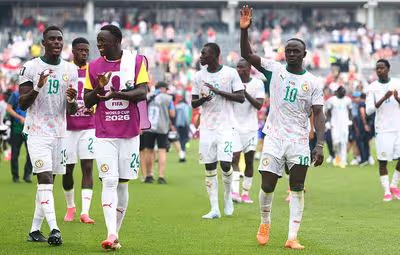
Fall framed the claim as part of broader concerns about the support structure around the national team during the tournament.
Immediate rebuttal from medical community
The Senegalese Association of Sports Medicine swiftly rejected Fall's assertion, describing it as unfounded and defamatory. The association maintains that Dr Fediore holds a specialist diploma in sports medicine and has been the national team doctor since 2017.
Timing and fallout: World Cup disappointment and coaching changes
The controversy arrives in the wake of Senegal's poor World Cup showing, capped by a last-32 loss to Belgium after surrendering a two-goal lead. The defeat prompted the dismissal of coach Pape Bouna Thiaw and his technical staff, intensifying questions about accountability across the federation.
Why the dispute matters
Medical competence is not a peripheral issue — it is central to player welfare, recovery and performance at elite tournaments. Public disagreements between federation leadership and the medical community erode trust within the squad and complicate recruitment of trusted specialists ahead of major qualifiers and tournaments.
Governance and accountability under the microscope
This episode exposes gaps in internal communication and oversight. Whether the dispute stems from miscommunication, personnel disputes, or governance failures, the end result is reputational damage for Senegalese football at a moment when stability is needed most.
What happens next
An authoritative response will be required: verification of medical credentials, transparent explanations of selection processes for team staff, and clear lines of responsibility between federation executives, coaching staff and medical personnel. Independent review or a formal audit would be a logical step to restore confidence, though any process must be handled with care to avoid further destabilising the national setup.
Broader implications for Senegal's national team
Beyond reputational risk, persistent internal conflict can affect player morale and preparation. Senegal will need coherent leadership and trusted medical support to rebuild after the World Cup and to mount credible campaigns in qualifiers and continental competitions.
Analyst view
At stake is more than an individual doctor’s CV: this is a test of institutional maturity. The federation's handling of the dispute will signal whether Senegalese football can translate its on-field potential into consistent off-field professionalism.
From terraces to the pitch: 'Wonderwall' rises as England's unexpected World Cup anthem
Clear, prompt and transparent action is the only credible way to move past a controversy that combines medical, managerial and sporting dimensions.
 The Independent
-(3)-1783705800.png?w=150&q=70&fit=cover)