
Machine-learning simulations of the expanded 48-team World Cup — 100,000 tournament runs using team and player data, market values and historical results — name Spain as the slight favorite (14.5%), with England and France close behind (12.4% each) and Germany at 11.2%. The wider format tightens the front‑pack; the U.S. has a strong Round of 32 chance (78%) but only a 1% probability of a home final win at MetLife Stadium.
Spain emerges as narrow favorite after 100,000 World Cup simulations
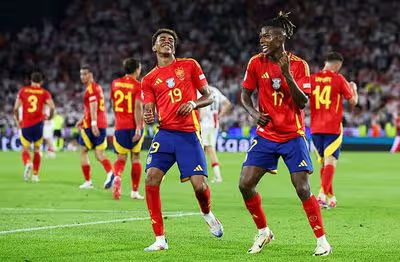
Spain tops the probabilistic leaderboard at 14.5%, followed by England and France (12.4% each) and Germany (11.2%). The simulation used 100,000 tournament runs to map how the expanded 48-team format reshapes title odds and concentrates contenders into a compact group.
Why the favorites are so tightly packed
The jump to 48 teams and more knockout rounds has diluted the gap between elite sides. A single upset in early knockout rounds now reverberates further, producing smaller marginal differences between top teams. That makes Spain’s advantage genuine but fragile; a 14.5% chance signals favoritism, not inevitability.
What the model says about other contenders and the U.S.
Portugal (8.9%) and Argentina (8.2%) sit as serious contenders rather than clear favorites. Germany’s 11.2% and England/France’s identical probabilities underline how form and tournament structure matter more than headline talent lists. The United States posts a 78% probability to reach the Round of 32 — the best in their group — but survival rates drop sharply in knockout play, and the model assigns only a 1% chance of a home victory in the final at MetLife Stadium.
Illustrative match-level forecasts
The engine models each match as a probabilistic outcome — comparable to “loaded dice” for goals. For example, Mexico’s opener projects roughly 1.9 expected goals versus South Africa’s 0.7, translating to a 65% win probability for Mexico. These match-level expectations roll up into group and knockout paths across the simulations.
How the machine‑learning engine works
The forecast blends retrospective performance, forward-looking market signals, player-level contributions and country context. Retrospective strength comes from international match results over recent years; prospective signals are derived from market odds and expert assessments. Player ratings incorporate club and national contributions to goals, while market-value estimates (from public valuation aggregates) proxy current quality and potential.
Why a random forest?
A random forest — many decision trees trained on historical tournament data — identifies which variables actually predict goals and outcomes under World Cup conditions. Trained on major tournaments since 2006, the model links team strength, player value and contextual features (FIFA ranking, presence of players deep in club competitions, socioeconomic factors) to scoring distributions that feed the simulations.
What this means for teams and fans
For contenders, the message is urgency: small edges in squad selection, fitness and tactical clarity can swing tight probabilities. For dark horses, tournament variance is double-edged — the expanded field increases opportunity for surprises but also demands consistency across more matches to capitalize. For hosts, home crowds help, but a 1% final-win projection at MetLife underlines how difficult converting home advantage into a title remains.
Limitations and practical takeaways
Probabilistic forecasts quantify likelihoods, not certainties. Models depend on input quality — injuries, sudden form shifts or tactical innovations remain hard to predict. Still, running 100,000 simulations provides a robust map of plausible tournament paths and highlights which teams must be watched closely.
Bottom line
Machine learning gives a clearer sense of where the balance of power lies: Spain leads a tightly bunched group of elite contenders, England and France remain close rivals, and Germany retains serious claims.
Fabrizio Romano confirms Liverpool star is expected to leave this summer
The expanded World Cup rewards consistency and makes early knockout matches disproportionately influential — meaning marginal advantages could decide who lifts the trophy.
 The Independent