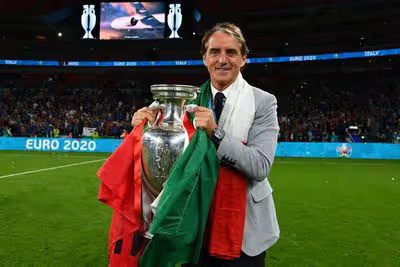
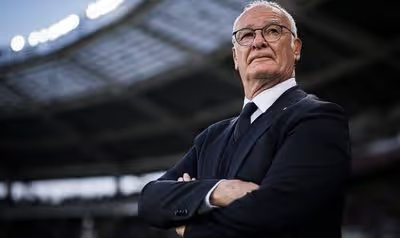
Roberto Mancini has been reappointed Italy manager with Claudio Ranieri named technical director, ending a week of turmoil that saw Paolo Maldini resign after 16 days and Andrea Pirlo ruled out. The FIGC has opted for experienced, familiar leadership as it seeks stability and clearer direction ahead of Nations League fixtures against Belgium and Turkey.
Roberto Mancini returns as Italy coach; Claudio Ranieri to oversee technical direction
The appointments in brief
Italian football federation FIGC president Giovanni Malagò confirmed Roberto Mancini will take charge of the national team for a second spell, while Claudio Ranieri assumes the newly prominent role of technical director responsible for elite development and technical strategy across Italy’s national teams.
Paolo Maldini resigned from the technical director post after 16 days amid internal disagreement, and Andrea Pirlo was not approved amid concerns raised within the federation.
Why the FIGC moved fast
The federation wanted experienced hands to steady a ship that has drifted since the highs of Euro 2020 and the lows of recent World Cup qualification failures. Mancini offers instant name recognition and a proven record with the national setup. Bringing in Ranieri adds institutional oversight and a managerial voice with extensive domestic and international experience.
What this means on the field
Mancini’s remit: immediate results and rebuilding
Mancini inherits a squad in need of clarity and direction. His previous tenure delivered Euro 2020 glory and a world-record 37-game unbeaten run, but it also ended with failure to qualify for the 2022 World Cup. Expect Mancini to prioritise tactical stability, leadership in midfield and a pragmatic approach to selection while attempting to restore confidence across the squad.
Ranieri’s role: technical coherence and long-term development
Ranieri will oversee technical operations and elite football development, a role that signals the FIGC’s desire to knit youth pathways to senior success. His managerial résumé—most notably the improbable Leicester title—brings credibility. Practically, Ranieri should influence coaching appointments, youth integration and the playing identity that Mancini will implement at senior level.
Backstory: the turbulence behind the appointments
Maldini’s abrupt exit and the Pirlo controversy
Paolo Maldini’s quick departure underlined internal divisions. Andrea Pirlo was reportedly blocked by senior FIGC figures over commercial ties that generated concern, leaving the federation to pivot back to proven names. Earlier approaches to Pep Guardiola and Carlo Ancelotti were rebuffed, narrowing FIGC options and sharpening the case for familiar faces.
A return to the familiar rather than a new evolution
Opting for Mancini and Ranieri is a conservative, risk-averse choice. It prioritises short-term stability and public reassurance over radical overhaul. That approach can arrest decline quickly, but it also leaves unanswered questions about structural reform and fresh tactical identity.
Context: Mancini’s mixed legacy
Past highs and recent lows
Mancini is still the coach who restored pride to Italy after the 2018 World Cup miss, guiding them to Euro 2020 success. Yet his tenure stalled: failure to navigate World Cup qualification and an eventual resignation in 2023 exposed limitations. His comeback will be judged on whether he can blend his proven motivational strengths with clearer tactical solutions to current deficiencies.
Immediate calendar and tests
Nations League offers a fast barometer
Italy’s Nations League campaign opens at home to Belgium on 25 September, followed by a trip to Turkey on 28 September. Those fixtures provide a compressed, high-stakes testing ground for new management decisions, player selection and tactical tweaks. Strong results would buy time and legitimacy; poor results would amplify pressure and reignite governance questions.
Analysis: stability, scrutiny and the road ahead
Why this appointment matters beyond results
The pairing of Mancini and Ranieri reveals the FIGC’s priority: restore credibility and control. For fans and players, the message is one of experienced stewardship. For the federation, the challenge is to translate short-term calm into long-term structural improvement—particularly in youth integration, coaching standards and oversight.
What to watch next
Watch for early indicators of change: squad selection balance between veterans and emerging talent, tactical shifts from Mancini, and the extent to which Ranieri reshapes youth coaching and recruitment. The cohesion between coach and technical director will determine whether Italy merely stabilises or builds toward sustained competitiveness.
Conclusion
Calculated reassurance, not a revolution
The FIGC’s choices buy time and bring respected figures back to the helm, but they are pragmatic more than visionary. Success will depend on clear alignment between Mancini’s short-term demands and Ranieri’s long-term framework.
John Stones to complete Inter switch with medical in Milan on July 30
If that alignment holds, Italy can realistically aim to rebuild confidence and competitiveness; if it fractures, the federation may find itself confronting familiar turbulence once again.
 Mirror