
MLS executives and club leaders are positioning the league for a second U.S. soccer boom around the 2026 World Cup, arguing marquee signings and a record number of MLS players at the tournament can convert casual viewers into local fans. LAFC co-founder Larry Freedman says strategic scheduling and storytelling — including high-profile fixtures like El Trafico — are designed to seize that moment.
MLS eyes a second soccer boom as 2026 approaches
Major League Soccer is treating the 2026 World Cup as a strategic inflection point. After the post-1994 uplift, MLS now believes a new, broader audience can be captured by combining global stars, homegrown talent and careful fixture planning.
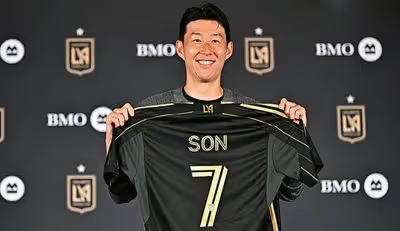
League insiders argue this is not nostalgia; it's an effort to convert tournament viewers into season-long supporters.
Why 2026 could change perceptions
MLS has long battled the “retirement league” label. That reputation is eroding as modern marquee signings arrive with competitive motives rather than farewell tours. The presence of high-profile captains and starters from host nations — and a growing number of elite players choosing MLS for serious reasons — gives the league fresh credibility on the world stage.
Numbers that matter
MLS will have a record 44 active players at the World Cup, and 103 players in the tournament have spent time in the league. Those figures are marketing gold: each televised World Cup moment is a chance to point viewers back to a local club where the player can be followed week-to-week.
LAFC’s playbook: community, access and timing
LAFC co-founder Larry Freedman frames his club and the league as ready to convert casual interest into committed fandom. Emphasizing community, accessibility and smart scheduling, MLS has placed marquee matches on non-World Cup days to fill the void for viewers hungry for top-level soccer. High-profile fixtures such as El Trafico (LAFC vs LA Galaxy) are being used as hooks to retain attention after tournament matchdays.
Media partnerships and storytelling
Broadcasters are a central part of the plan. By aligning with partners to highlight MLS players’ World Cup performances, the league aims to create direct storylines — “watch this player at the World Cup, then watch him live in your city” — that can translate into viewership and attendance.
Gareth Bale and the narrative shift
Marquee arrivals like Gareth Bale have challenged the old narrative that MLS is purely a final destination. When established players arrive with competitive intentions — to prepare for tournaments or extend peak form — the league benefits from upgraded perceptions of quality. That shift matters because reputation influences both fan engagement and player recruitment.
What this means for MLS growth
If MLS can convert even a fraction of World Cup viewers into regular supporters, the league’s commercial and cultural footprint will expand. More attention creates pressure for better stadia, youth development and broadcast product, but also offers upside in sponsorship, local engagement and international respect.
Risks and limitations
The challenge is real: MLS competes for attention with Europe’s elite leagues and must continually prove on-field quality and competitive consistency. Scheduling, broadcast reach and narrative execution will determine whether the World Cup moment becomes sustained growth or a temporary spike.
What to watch next
Look to how MLS markets players featured at the World Cup, the viewership and attendance for high-profile non-tournament fixtures, and any uptick in season ticket or local media interest.
Koreatown fan tackles shooter at LA World Cup watch party; officer's tourniquet likely saved him
The league’s ability to convert curiosity into habitual consumption will be the true test of whether a second soccer boom arrives in the United States.
 Mirror