Leandro Paredes says Lionel Messi has played his final match for Argentina after the World Cup final defeat, a claim that, if true, signals the end of an era and forces Argentina to accelerate a post‑Messi rebuild ahead of upcoming Copa America and World Cup cycles.
Messi's Argentina future in doubt after Paredes' blunt claim
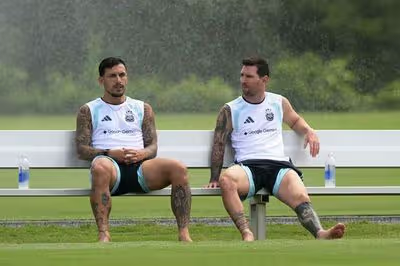
Leandro Paredes publicly suggested Lionel Messi has decided to stop playing for Argentina, saying “I think he has made his decision, and that it really was his last match with the national team.”
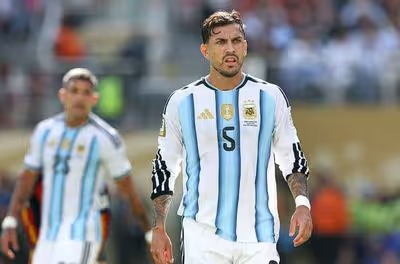
The remark came as Paredes returned to Boca Juniors and helped secure a 1-0 win, underlining how quickly the narrative around Messi's international future has shifted from performance to succession planning.
Immediate context: World Cup final and aftermath
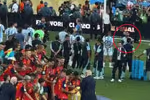
Argentina lost the World Cup final 1-0 after extra time, a crushing end to a tournament in which Messi rediscovered his global dominance. He scored eight goals en route to the final and remained Argentina’s chief creative and attacking threat throughout the event. The final itself saw Spain largely control play, and Messi was visibly emotional upon receiving his runner-up medal.
What Paredes actually said
Paredes offered a strikingly definitive line about Messi’s future: “I think he has made his decision, and that it really was his last match with the national team.” He tempered that with personal hope—“I hope that is not the case, and I hope he can carry on playing”—but framed the decision as Messi’s alone. The teammate’s confidence gives the claim weight beyond idle rumor because Paredes is an insider who shares close locker-room ties with Messi.
How Messi performed and why his potential exit matters
Messi’s World Cup output — eight goals and decisive assists — proved he remains elite at international level. He produced key plays in knockout matches, including a late assist to Enzo Fernández and a stoppage-time cross that led to Lautaro Martínez’s header against England in the semifinal. Those moments underline why his presence is more than symbolic: he still changes matches.
The possible loss of Messi’s international presence is both tactical and psychological. Tactically, Argentina loses its primary creator and reliable goal threat. Psychologically, his leadership and aura have helped keep a transition balanced; without it, younger players must absorb pressure much sooner.
Club-side timeline and logistics
Messi has missed the MLS All-Star Game due to an advised 21-day post-tournament break that many Argentina players are taking, though Inter Miami have managed wins in his absence. Paredes returned to action for Boca Juniors immediately and contributed an assist in a 1-0 victory over O'Higgins, highlighting different approaches to post-World Cup rest and recovery across players and clubs.
What this means for Argentina's short- and mid-term plans
If Messi retires from international duty, Argentina faces an expedited rebuild. Coaching staff must clarify who will inherit Messi’s playmaking responsibilities and which formation best suits a post‑Messi attack. Candidates will need clear roles: a chief creator, a penalty-box presence, and someone to marshal set-piece and dead-ball situations.
The timing also affects tournament cycles. If Messi is indeed stepping away, Argentina will enter the next Copa America and World Cup qualifying period without its talisman, forcing early experiments and possibly a re-evaluation of squad selection and youth integration.
Age and longevity considerations
Paredes referenced Messi’s stage of career implicitly, and the numbers are relevant: the player discussed in these comments is near the twilight of a decades-long international run. That reality factors into any retirement decision and explains why teammates and fans are emotionally invested in whether he continues.
Outlook: what likely happens next
National team officials will need to confirm Messi’s status publicly to remove uncertainty. In the short term, expect Argentina to accelerate talent identification and provide young stars with extended minutes in friendlies and competitive fixtures. In the medium term, tactical adjustments will be unavoidable.
From an analytical perspective, Paredes’ statement should be treated seriously but not as irreversible until Messi himself speaks. Even so, the Argentine setup must prepare for both outcomes: honoring Messi’s legacy while constructing a plan that preserves competitive standards without him.
Bottom line
Paredes’ comments have turned a post-World Cup discussion into an urgent planning issue for Argentina.
Darwin Nunez poised to return to Portugal as Benfica and Porto lead loan race
Whether Messi formally retires or delays the decision, Argentine football stands at a crossroads: maintain short-term competitiveness or begin a deliberate rebuild to define the next era.
 The Mirror Us