FIFA's plan to spin off a $20bn commercial arm, selling a 20% stake to private investors to raise roughly $4.2bn, has provoked a fierce UEFA backlash and prompted emergency talks among its 55 member associations — raising the real prospect of an unprecedented boycott and a governance fight over whether football's flagship assets can be partially privatized.
UEFA threatens boycott after FIFA unveils plan to sell stakes in World Cup
FIFA's proposal to create "FIFA Forward Enterprise" and invite private capital into the World Cup's commercial ecosystem has sparked immediate institutional resistance, with UEFA warning the move crosses a line on governance and transparency.
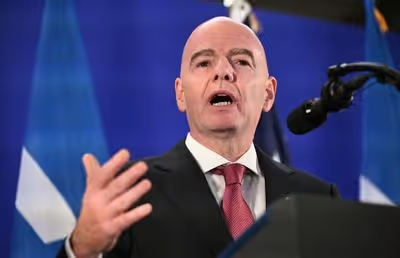
The controversy centers on whether the sport's global showcase and related competitions should be treated as tradable commercial assets.
What FIFA is proposing
FIFA plans to partner with major financial players to launch a new commercial vehicle valued at around $20 billion. The organization aims to raise approximately $4.2 billion by selling a 20% stake to private investors, with JP Morgan reported as an adviser and investment groups linked to Joshua Kushner among potential backers. The model would create a standalone company to manage rights and commercialization across the World Cup, Club World Cup, Women's World Cup and other tournaments.
UEFA's response and the prospect of a boycott
UEFA's 55 member associations have described the proposal as a fundamental threat to football's governance, asserting the "soul" of the game is not a commodity to be sold without full transparency. An emergency virtual meeting is planned. If UEFA follows through with coordinated resistance — up to and including boycotts — the move would be historic and could disrupt the sport's global calendar and commercial certainty.
Why this matters for clubs, leagues and national federations
Selling minority commercial stakes changes power dynamics. Private investors will expect returns and influence over long-term brand and rights strategies, potentially prioritizing revenue maximization over federations' and supporters' interests. Clubs, domestic leagues and national associations face a governance choice: protect collective stewardship of competitions or accept a more market-driven model that could alter distribution of income and control.
Financial and leadership implications
The proposed setup could reshape executive incentives. Reports suggest the deal could significantly raise earnings tied to the new entity's leadership, altering the neutrality typically expected from governing officials. That prospect has intensified concerns about conflicts of interest and accountability within FIFA's governance structure.
Context: the commercial stakes are already massive
The business case rests on a booming World Cup market. The 2026 World Cup generated record revenue — around $15 billion — and delivered huge broadcast audiences, underlining why investors see long-term value. Yet the scale of those returns is precisely what makes federations wary of ceding control without ironclad safeguards.
What could happen next
Immediate outcomes to watch:
- UEFA's emergency meeting could yield a coordinated rejection, formal legal challenges, or an ultimatum demanding transparent terms and governance safeguards.
- Other confederations may align with or resist UEFA's stance; a split would complicate any privatization attempt.
- FIFA could revise the proposal to provide stronger oversight, governance guarantees, or reduced commercial control to assuage partners.
Analysis: governance versus commercialization
This is a governance test as much as a commercial negotiation. Football's institutions must balance capitalizing on global demand with preserving legitimacy among federations, clubs and fans.
If FIFA presses ahead without meaningful concessions, it risks alienating European federations whose competitions and talent pool underpin the World Cup’s value.
Conversely, a negotiated framework that preserves independent oversight and equitable revenue distribution could unlock fresh investment while safeguarding the game's integrity.
Bottom line
FIFA's commercial ambitions have exposed a deep rift over who should control football's crown jewels.
European federations threaten boycott as FIFA moves to sell stake in new commercial arm
The coming days will determine whether the sport moves toward a U.S.-style private equity model or reasserts collective governance — a decision with major financial and cultural consequences for world football.
 The Mirror Us