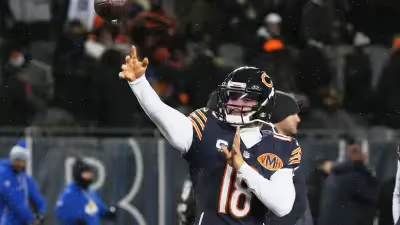
Caleb Williams escalated pressure on NFL owners to adopt natural grass league-wide after several NFL stadiums installed grass for the 2026 FIFA World Cup. The Chicago Bears quarterback — who plays on grass at Soldier Field — asked “Why Can’t We Have This Too?” and aligned with players pushing the NFL to prioritize player safety over turf-driven economics.
Caleb Williams leads renewed push for natural grass in NFL after World Cup installations
Caleb Williams publicly joined a growing player movement calling for more natural grass fields across the NFL, igniting debate after multiple NFL venues laid sod to host 2026 FIFA World Cup matches.
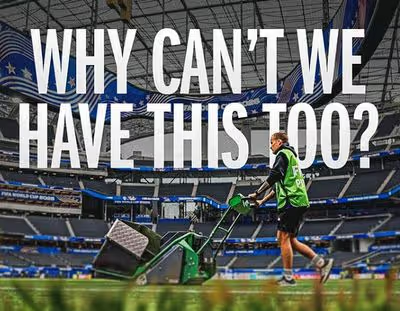
Williams shared a graphic on X asking, “Why Can’t We Have This Too?” and used the hashtag #WorthTheCost, signaling support for player-led demands that clubs rethink artificial turf.
What happened: World Cup showed grass is possible at NFL stadiums
Eleven NFL stadiums were selected to host World Cup games; seven temporarily replaced artificial turf with natural grass to meet FIFA standards. Those fields are expected to revert to turf ahead of the NFL season, a move that has provoked players who see the temporary switch as proof that permanent conversions are feasible when organizers accept the expense.
Why players — and the NFLPA — want grass
Players and the NFL Players Association argue natural grass offers better playing conditions and poses fewer surface-related injury concerns than many artificial turfs. Beyond safety, grass affects footing, ball behavior and the way offenses and defenses execute at the margins — elements that matter to quarterbacks, linemen and skill players alike.
Owners’ counterarguments: cost, logistics and multipurpose venues
Team owners resist a league-wide switch largely for economic and operational reasons. Natural grass can be costly to install and maintain, especially in multipurpose or retractable-roof stadiums that host concerts, soccer and other events. For some franchises, turf yields more scheduling flexibility and lower upkeep complexity.
Context: Williams’ stance matters beyond his own sideline
Williams isn’t speaking from turf disadvantage — Soldier Field has used natural grass since 1988. His advocacy therefore reads as league-wide leadership rather than a local gripe. That amplifies the message: this isn’t just about comfort where one franchise plays, it’s a collective-player issue tied to health, longevity and performance.
On-field stakes: Williams’ pivotal third season with the Bears
The timing of Williams’ post coincides with a crucial stage in his career. After a rocky rookie year, Williams vaulted into elite discussion under head coach Ben Johnson in 2025, guiding the Chicago Bears to an 11-6 record, an NFC North title and the franchise’s first playoff win since 2010.
He set a Bears single-season passing mark (3,942 yards), threw 27 touchdowns and led the league in game-winning drives (seven). Entering 2026, Williams faces elevated expectations as the Bears navigate one of the league’s toughest schedules.
Why this move is significant for Williams and the Bears
For Williams, taking up a broader player welfare cause doubles as leadership signaling: he’s building influence off the field while his on-field trajectory remains under scrutiny. For the Bears, the spotlight on Williams’ advocacy both humanizes the young franchise star and ties player health priorities to organizational decision-making.
What could follow: practical options and likely next steps
A permanent league-wide conversion is unlikely overnight. More probable outcomes include individual teams adopting grass where practicable, increased investment in hybrid surfaces, or targeted upgrades at player-safety hot spots. The NFL Players Association may use collective bargaining leverage or publicity campaigns to press owners, while owners will continue to weigh costs, stadium usage contracts and local climate constraints.
Why it matters
This debate transcends aesthetics: it affects injury risk perceptions, player career lengths, tactical play and franchise finances. The World Cup installations have reframed the conversation by proving grass can be installed at scale for premier events.
That demonstration hands players and the NFLPA a clearer argument — and puts pressure on owners to reconcile short-term costs with long-term player welfare and competitive integrity.
 Sporting News