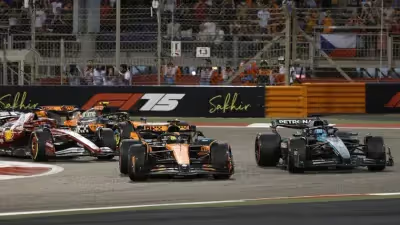
Formula 1 has been forced into an unscheduled month-long break after the Bahrain and Saudi Arabian Grands Prix were cancelled over regional security and logistical concerns, reducing the 2026 season to 22 races. Mercedes have been the early pace-setters, with George Russell and teammate Kimi Antonelli near the top of the standings, while defending champion Lando Norris searches for form ahead of the resumed campaign in Miami.
F1 enters unscheduled break after Middle East cancellations
The Bahrain and Saudi Arabian rounds have been removed from the 2026 calendar following safety assessments and logistical complications related to heightened regional tensions. Formula 1 has confirmed the races will not be rescheduled, trimming the season to 22 events and creating a five-week gap between the Japanese Grand Prix and the Miami weekend.

Why the cancellations matter
Safety of personnel and the reliable movement of team equipment were cited as primary concerns. Organisers said transporting cars and chassis through the region — including shipping routes such as the Strait of Hormuz — presented unacceptable logistical risk amid ongoing hostilities in the wider Middle East.
This is not just a calendar decision: missing two early rounds shifts championship dynamics, breaks momentum for teams that had been building form and creates a condensed run of events later in the year.
Immediate sporting impact: standings and momentum
Mercedes have emerged as early pacesetters, with George Russell and teammate Kimi Antonelli occupying the top positions in the drivers’ standings. That early advantage will now sit idle, allowing rivals time to regroup and engineers to reconsider development paths without immediate race verification.
Defending champion Lando Norris heads into the break under pressure; his struggles to adapt to a new car leave McLaren with work to do during an unscheduled window that could either help find solutions or entrench early-season deficits.
What this means for teams and strategy
The break gives teams extra engineering and simulation time, but also disrupts the iterative upgrade-and-validate rhythm that racing normally enforces. For front-runners, the pause is a chance to consolidate; for midfield squads, it’s an opportunity to close gaps without the crucible of back-to-back races.
Logistically, the decision reduces immediate travel strain but tightens later logistics as the season remains crowded. Teams will need to recalibrate development schedules and update shipping plans for a denser second half of the year.
Will the Bahrain and Saudi Arabia rounds be rescheduled?
No. Organisers have confirmed the two races will not be replaced or rescheduled. That means the official 2026 championship will proceed with 22 Grands Prix, rather than the previously planned 24.
Saudi Arabia’s sports ministry said the country was prepared to host, but the decision to cancel stands, leaving the calendar unchanged except for the missing events.
When does F1 return?
With the cancellations, fans face a five-week gap between the Japanese Grand Prix (27–29 March) and the Miami race weekend (1–3 May). Miami now becomes the first action after the extended pause — a high-profile sprint-format event that will reset championship narratives.
Broadcast and viewing rights (United States)
Apple TV holds the exclusive rights to broadcast Formula 1 in the United States for the 2026 season. The streaming service will carry practice sessions, qualifying, sprints and Grands Prix per the rights agreement. Broadcasters and platforms internationally vary by territory.
Revised 2026 race calendar (22 rounds)
March 6–8 — Australia, Melbourne
March 13–15 — China, Shanghai (Sprint)
March 27–29 — Japan, Suzuka May 1–3 — USA, Miami (Sprint)
May 22–24 — Canada, Montreal (Sprint)
June 5–7 — Monaco, Monte Carlo
June 12–14 — Spain, Barcelona-Catalunya
June 26–28 — Austria, Spielberg
July 3–5 — Great Britain, Silverstone (Sprint)
July 17–19 — Belgium, Spa-Francorchamps
July 24–26 — Hungary, Budapest
August 21–23 — Netherlands, Zandvoort (Sprint)
September 4–6 — Italy, Monza
September 11–13 — Spain, Madrid*
September 24–26 — Azerbaijan, Baku
October 9–11 — Singapore (Sprint)
October 23–25 — USA, Austin October
30–November 1 — Mexico City
November 6–8 — Brazil, São Paulo
November 19–21 — USA, Las Vegas
November 27–29 — Qatar, Lusail
December 4–6 — Abu Dhabi, Yas Marina
Notes on the calendar
Madrid is the latest addition to the schedule. The United States will host three races in 2026, the most of any country. Six sprint weekends are included in the revised calendar.
Looking ahead: implications for the title fight
The extended break effectively freezes the pecking order. Teams with early pace — notably Mercedes — can consolidate their advantage without immediate testing under race conditions, but rivals gain runway to address weaknesses. For drivers, momentum is fragile; a hot streak can cool, while an off-color start can be reset.
F2 to join F1 bill in Miami and Canada
Analysis: pragmatism won here. Canceling rounds when personnel safety and reliable logistics are in doubt avoids a chaotic, compromised spectacle. The trade-off is a season with a different rhythm — and an amplified premium on performance when the action resumes in Miami.
 Sporting News