Mikel Merino struck in the closing minutes to beat Belgium and book Spain a World Cup semifinal spot — his second consecutive match‑winner off the bench and a clear signal that Luis de la Fuente’s tactical use of substitutes has become the defining edge for La Roja.
Merino’s late goal sends Spain past Belgium in World Cup quarterfinal
Spain advanced to the World Cup semifinals after Mikel Merino came off the bench and converted a loose ball late against Belgium, completing a comeback in a tight quarterfinal.

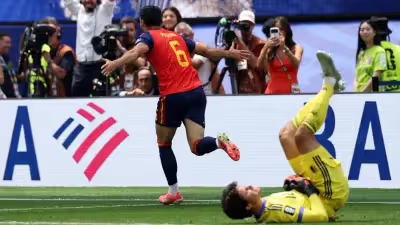
The 30-year-old entered in the 86th minute and made the decisive intervention on a broken play when Belgium goalkeeper failed to control a shot, allowing Merino to finish clinically and secure the win.
How the goal unfolded
Merino replaced tired legs in a low‑scoring encounter where Spain’s defense had once again dominated possession and limited chances. A chaotic sequence in the box saw the Belgian keeper unable to gather a strike cleanly; Merino reacted quickest, cleaned up the rebound and buried the chance to break the deadlock in the final moments. The finish was simple but decisive — the hallmark of a player schooled in timing and composure.
Why Merino is Spain’s super‑sub
Luis de la Fuente has repeatedly deployed Merino as a late offensive spark, and the tactic is paying off. Spain’s tournament identity so far has been defensive solidity and control; Merino offers a contrasting profile—fresh legs, directness in the penalty area and an instinct for late runs. Coming on in the 85th and 86th minutes in recent knockout rounds, he’s converted that limited time into two game‑winning moments, proving the substitution plan is more than tactical theater.
What his role reveals about Spain’s strategy
Spain’s backline and midfield have suffocated opponents, but creativity inside the box has often arrived via substitutions. Merino’s effectiveness underscores a deliberate management approach: conserve structure early, then inject a forward‑thinking option when the opposition tires. That combination of discipline and punch is a pragmatic evolution of La Roja’s usual possession model.
Club form and career background
Merino, who has spent the past two seasons with Arsenal, brings regular high‑level minutes from the Premier League to international duty. His recent club record — 11 goals in 50 appearances with 27 starts — reflects an ability to score without being a consistent starter. Earlier spells in Spain with Real Sociedad and time at Osasuna, Dortmund and Newcastle contribute to a résumé built on adaptability and technical poise.
What this means for Spain’s semifinal prospects
Merino’s back‑to‑back late winners give Spain a clear tactical advantage: opponents now must plan for not only the starting XI but also a bench weapon capable of changing the game. For Luis de la Fuente, that depth eases selection dilemmas and allows Spain to preserve its defensive foundation while retaining an explosive option late.
The semifinal will test whether Merino’s knack for decisive interventions continues, and whether rivals can adjust to neutralize him without destabilizing their own game plan.
Looking ahead
Spain advance with momentum and a blueprint — lock down defensively, then deploy targeted substitutions to finish matches.
Lammens' late fumble hands Spain victory and spotlights United's transfer priorities
How opposing coaches respond to Merino’s impact will shape the next phase; for now, La Roja can take confidence that their late‑game formula has carried them into the final four.
 Sporting News