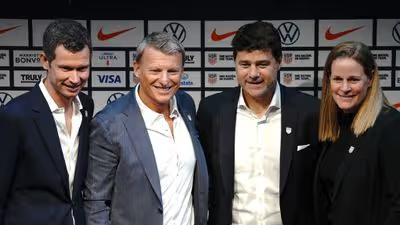
Breaking: US Soccer sporting director Matt Crocker is leaving for a role in Saudi Arabia just weeks before the 2026 World Cup, creating a leadership vacuum that raises urgent questions about USMNT preparation, Mauricio Pochettino’s future and the federation’s long-term blueprint; critics say Crocker’s exit exposes strategic shortcomings and forces rapid decisions on coaching stability and match scheduling ahead of a home World Cup.
Matt Crocker departs as US Soccer faces critical pre-World Cup period
Matt Crocker has resigned as US Soccer’s sporting director to take a position in Saudi Arabia, a move that lands at the worst possible moment for the federation: mere weeks from the 2026 World Cup on home soil. The timing amplifies the challenge of maintaining continuity across technical planning, player pathways and competitive preparation.
Immediate fallout for the USMNT and coaching staff
Crocker’s exit instantly creates uncertainty around the USMNT’s preparation cycle. Sporting directors shape scheduling, international relationships and long-term talent development — functions that are especially crucial in the lead-up to a major tournament. Without a clear successor or interim structure, decisions on friendlies, training camps and overarching strategy risk delay or inconsistency.
Former USMNT striker and MLS analyst Taylor Twellman criticized Crocker’s tenure as lacking commitment to development at all levels, blaming strategic missteps for underwhelming results, including the 2024 Copa America. That critique matters because it reframes the departure not simply as a personnel change but as symptomatic of deeper planning and execution problems.
What this means for Mauricio Pochettino and managerial stability
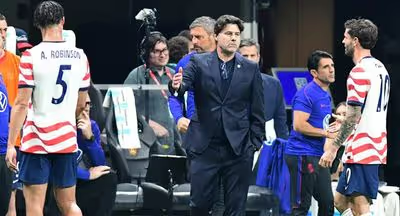
Crocker’s departure increases speculation about coaching continuity. Mauricio Pochettino’s long-term commitment could hinge on the federation’s ability to present a stable technical leadership and a clear roadmap through 2026. While Pochettino has overseen preparations, a change in sporting direction often precipitates reassessment of managerial projects — a risk the federation must manage proactively.
Preparation gaps: friendlies, scouting and the wasted opportunities
Critics point to a lack of high-quality friendlies and perceived underuse of competitive windows as major preparation failures. The Copa America disappointment is cited as evidence that the current cycle has not maximized the squad’s potential. Those gaps are not just tactical; they affect player readiness, scouting intelligence and the institutional credibility of US Soccer ahead of a global stage where expectations will be high.
What US Soccer must do next
Appoint an interim sporting director or empower a capable internal leader immediately to preserve continuity and execute the existing World Cup plan.
Prioritize confirming Pochettino’s commitment publicly or secure contingency coaching plans to avoid last-minute upheaval.
Lock in a slate of high-quality friendlies and targeted training camps to sharpen match fitness and tactical cohesion.
Communicate a revised five- to ten-year blueprint that reassures clubs, players and fans about youth development and pathway investment.
Longer-term consequences and the opportunity for a reset
This departure is a test of US Soccer’s institutional resilience. On one hand, it magnifies pre-existing weaknesses in planning and execution. On the other, it offers a rare chance to recalibrate ahead of a home World Cup: a new sporting director could bring renewed focus on development, scheduling and international partnerships.
Taylor Twellman’s blunt prescription — “quarter-final or bust” — captures the high-stakes expectations now placed on the squad and federation. Failure in 2026 would intensify scrutiny; success could validate a rapid, decisive transition.
Bottom line
Matt Crocker’s exit removes a central figure from US Soccer at a pivotal moment, forcing immediate organizational decisions with tournament implications.
England beat Spain in Women's World Cup qualifier
The federation’s response over the coming weeks will determine whether the USMNT enters 2026 consolidated and competitive — or fractured and exposed.
 The Sun