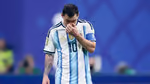
With World Cup 2026 knockouts underway, quarter-final ties cannot finish level: matches deadlocked after 90 minutes go to 30 minutes of extra‑time (two 15‑minute halves), and if still tied are decided by a penalty shoot‑out. Fitness, tactical substitutions and game management will increasingly shape England, France, Spain and Argentina’s paths to the final.
Do World Cup quarter-finals go to extra-time?
Yes. In World Cup knockout matches — including the quarter-finals — a winner must be produced on the day. If teams are level after 90 minutes, the match proceeds to extra‑time: two 15‑minute halves played in full. If neither side breaks the deadlock after the extra 30 minutes, the tie is settled by a penalty shoot‑out.
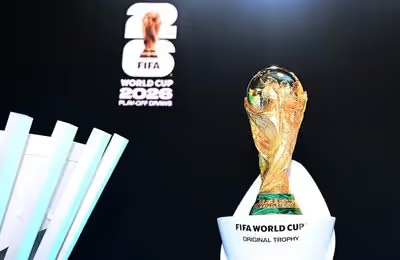
How extra-time works
Extra‑time is a single 30‑minute period split into two 15‑minute halves. The clock runs continuously; there is no golden goal. Referees will add stoppage time for injuries and delays within each half, and teams will generally have a short interval between the end of 90 minutes and the start of extra‑time.
Penalty shoot‑out procedure
If scores remain level after extra‑time, the outcome is decided by penalties. Each team alternates spot‑kicks in a best‑of‑five format; if still tied, the shoot‑out moves to sudden‑death rounds until a winner emerges.
Key dates for the World Cup knockout rounds
July 9–11 — Quarter‑finals July 14–15 — Semi‑finals July 18 — Third‑place play‑off July 19 — Final
Why extra-time matters: tactical and squad implications
Extra‑time reshapes managerial decisions. Substitution timing, player stamina and bench depth suddenly take on outsized importance. Coaches must balance the immediate need to chase a result with conserving legs for the extra half‑hour and potential penalties. Those teams with athletic midfield engines and specialist penalty takers gain a tangible edge.
Game management and set‑piece value
As fatigue grows, set pieces and long‑range shots become higher‑value opportunities. Teams that can control tempo and protect a narrow lead will be rewarded, while sides that rely on a front three may run out of steam late, forcing tactical adjustments.
What this means for the favourites
England: With a deep squad and attacking stars such as Harry Kane and Jude Bellingham, England can both press for a result in 90 minutes and control extra‑time, but squad rotation and fitness will be decisive.
France and Spain: Tactical flexibility gives these sides an advantage in extra‑time scenarios. Both nations can switch formations and inject quality from the bench to tilt tight contests.
Argentina: Proven performers in high‑pressure moments, Argentina’s experience and composure can be decisive in shoot‑outs, but they will still need to manage workload across 120 minutes.
Bottom line
Knockout football at the World Cup leaves no room for complacency: draws after 90 minutes lead to extra‑time and, if necessary, penalties.
Pick an honorary team: Eight World Cup quarterfinals to cheer for after the USMNT exit
As the tournament reaches its decisive phase, managers who master substitutions, fitness management and psychological preparation for spot‑kicks will often determine who advances.
 The Sun