


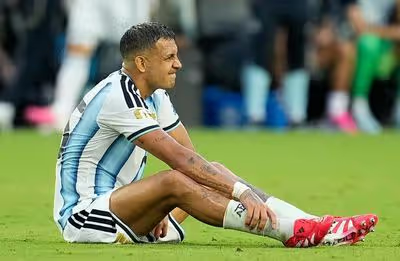
With the 2026 World Cup at the semi-final stage, several heavyweights face fitness headaches: France risk losing Kylian Mbappé to a minor ankle knock, England's Declan Rice and Reece James are battle-tested but fragile, Spain's wide options remain thin with Yeremy Pino and Víctor Muñoz sidelined, and Argentina lost Facundo Medina to a calf problem. Managers must juggle limited recovery time and thin defensive depth ahead of pivotal knockout ties.
Late-tournament injuries reshuffle World Cup contenders' plans
France, England, Spain and Argentina enter the business end of the World Cup with nagging absences that could shape semifinal matchups and tactical approaches. Several sidelined or compromised starters force managers to weigh risk versus reward in selection, minute management and tactical tweaks with precious recovery days remaining.
Why these injuries matter now
Losing or reducing the minutes of key players at this stage isn't just a personnel problem — it alters formations, pressing intensity and substitution strategy. With knockout margins thin, a compromised starter or limited bench depth can be decisive over 120 minutes and penalties.
France: Mbappé’s minor ankle knock and midfield doubts
Kylian Mbappé — precautionary withdrawal but upbeat
Mbappé was substituted after suffering a knock in the quarter-final against Morocco and sat with ice on his ankle. He described the issue as a "minor ankle injury" and downplayed concern, but France's medical staff removed him as a precaution. With roughly five days before their semi-final, Deschamps must balance preserving his talisman with maintaining attacking rhythm.
Aurélien Tchouaméni — groin management continues
Tchouaméni's ongoing groin problem has already cost him starts in recent matches. His absence or limited minutes would force France to adjust midfield balance, potentially sacrificing defensive shielding for ball progression.
England: defensive crisis persists despite encouraging signs
Declan Rice — illness disrupted preparation
Rice missed training for two days with illness before the Norway quarter-final, started the match but was replaced at half-time after looking off the pace. England have managed his neural back pain and workload through the tournament; the club-like approach has limits in knockout football where continuity and midfield control are vital.
Reece James — hamstring recovery and measured reintroduction
James returned from a hamstring problem to take a bench role against Norway after missing several matches. His reintroduction is a boost for England's right flank, but reliance on a player with limited recent minutes requires cautious rotation to avoid recurrence.
Jordan Henderson — surprising availability
Henderson suffered a fractured arm recovering from the Mexico win yet was surprisingly included among substitutes for the Norway quarter-final after surgery. His presence is morale-boosting and offers an experienced option if England need a steadying midfield figure, though any involvement will be managed tightly.
Spain: attacking width thin, defensive stability intact
Lamine Yamal — a fitness win for La Roja
Yamal has returned to full fitness and is a regular for Spain, giving Luis de la Fuente an important creative outlet and right-sided threat. His availability eases some pressure caused by other absences.
Yeremy Pino and Víctor Muñoz — persistent setbacks
Pino’s acromioclavicular sprain and Víctor Muñoz’s calf and subsequent muscular setbacks have left Spain short of options on the wings. That scarcity forces tactical conservatism or reliance on less-experienced wide players, potentially narrowing Spain’s attacking profiles against high-tempo opponents.
Argentina: defensive depth tested
Facundo Medina — calf problem weakens options
Medina’s calf issue removed another defensive option from Argentina’s pool, compounding earlier disruptions. With Cristian Romero returning earlier from a knee injury, Scaloni’s defensive rotation has been strained, making concentration and match tempo even more crucial for Argentina’s back line.
Other fitness questions and squad implications
How managers can respond
Coaches must decide between short-term fixes and preservation for later rounds. Options include tactical shifts — deeper full-backs, a pivot midfield to shield a makeshift back four, or fresh legs from bench players who have been unused. Recovery windows are tight; decision-making will favour players who can deliver immediate impact without risking long-term absence.
What this means for the semi-finals
Teams with greater depth and adaptable systems gain an edge.
France’s reliance on Mbappé and a tight midfield without Tchouaméni could be exposed by high-press opponents.
England’s defensive fragility forces cautious selection and may invite opponents to target transitional moments.
Spain’s narrowed wing options could blunt wide creativity against organized defences.
Looking ahead: recovery timelines and tactical forecasts
Short recovery periods make conservative management likelier: late substitutions, minutes limits and role simplification. Expect managers to prioritise match-control players and put questionable starters through final assessments. Where risk is taken, it will be a calculated gamble based on medical assessments, opponent profile and game state.
Bottom line
Fitness is the unsung variable now determining World Cup trajectories.
Small knocks can have outsized effects when margins are slim; the teams that adapt tactically and protect key assets without losing cohesion will be best placed to reach the final.
 Yahoo! News


