


Carlo Ancelotti declared the end of a generation in Brazil’s national team after the World Cup, naming Neymar, Danilo and Casemiro as veterans whose cycle has closed and urging a search for replacements ahead of the 2030 World Cup. He singled out Marquinhos as a keeper of leadership but left Alisson’s future open, stressing the need to evaluate young goalkeepers playing in Brazil’s domestic championship.
Ancelotti signals end of Brazil's veteran generation
Carlo Ancelotti delivered a blunt assessment: the World Cup marked the close of a generation that included Neymar, Danilo and Casemiro.
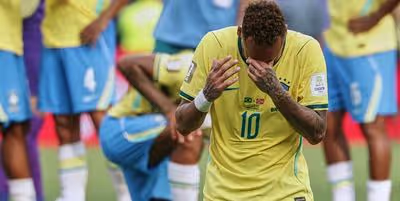
By calling those names he framed a necessary rebuild rather than a cosmetic refresh. For a nation that prizes continuity, the admission accelerates a transition period Brazil can no longer postpone.
Which positions face the biggest turnover?
Midfield and full-back depth are immediate concerns. Casemiro’s absence creates a tactical vacuum — the defensive midfield anchor who balanced Brazil’s game is not easily replaced. Danilo’s departure leaves experience and positional flexibility at full-back in short supply. Neymar’s role is more cultural than tactical now; his influence remains, but the squad will need new attacking patterns less reliant on one superstar.
Marquinhos offers continuity; Alisson’s status uncertain
Ancelotti singled out Marquinhos as an experienced leader who should remain in the fold — a logical choice given his captaincy and defensive command. The coach, however, gave no clear guarantee on Alisson, instead urging a look at younger goalkeepers in Brazil’s domestic competition. That signals a pragmatic reset in keeper succession planning rather than dogged loyalty.
Why goalkeeper evaluation matters
Goalkeeping transitions are often overlooked until costly mistakes force change. Ancelotti’s directive to scout domestic keepers elevates the Brazilian Championship as a talent pool and admits current uncertainty at the position. This is a subtle but important pivot: national-team steadiness increasingly depends on form and depth at home as much as on star power abroad.
What this means for Brazil’s 2030 World Cup strategy
Naming the end of a cycle is the first step toward long-term planning. Brazil now faces a multi-year task: identify replacements, integrate them into a coherent system, and build new leadership around remaining veterans like Marquinhos. The 2030 World Cup timeline gives breathing room, but it also demands deliberate squad construction and match exposure for younger players.
Practical implications for selectors and coaches
Expect accelerated scouting, earlier call-ups for promising youngsters, and tactical experiments to find a new spine for the team. Coaches will need to balance urgency with patience — rushing rebuilds risks dropping competitive standards, while delay allows other nations to widen the gap.
Bottom line
Ancelotti’s statement is both candid and corrective: Brazil must transition now. Retaining leaders such as Marquinhos buys stability, but the national team must replace key figures in midfield, defense and potentially goalkeeping.
How effectively Brazil manages that handover will define its competitiveness for the next World Cup cycles.
 Yahoo! News


