


Argentina face possible FIFA sanctions after players held a "Las Malvinas son Argentinas" banner during a jubilant celebration following their late comeback to beat England in the World Cup semi-final in Atlanta, reigniting a sensitive sovereignty dispute and risking disciplinary action ahead of the final against Spain.
Banner controversy overshadows Argentina's dramatic semi-final win over England
Argentina completed a stunning late turnaround to beat England 2-1 in the World Cup semi-final in Atlanta, only for the post-match celebration to be dominated by politics rather than sport. Players were photographed holding a banner reading "Las Malvinas son Argentinas" — a slogan asserting Argentina's claim to the Falkland Islands.
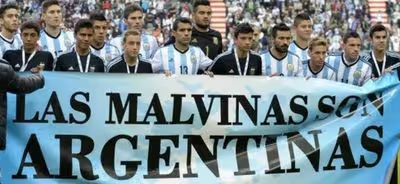
The image immediately raised the prospect of action from FIFA under rules that bar political demonstrations.
What happened on the pitch
England fell to late goals from Enzo Fernández and Lautaro Martínez, allowing the defending champions to reach the final against Spain. The on-field drama — and Argentina’s emotional reaction — were textbook tournament theatre. The victory should have been pure sporting triumph; instead, the banner shifted headlines toward history and geopolitics.
Why the banner matters
The Malvinas/Falklands sovereignty dispute remains deeply sensitive between Argentina and the UK, dating to the 1982 conflict that left hundreds dead on both sides. FIFA's disciplinary code explicitly prohibits political gestures by teams and players during competitions. There is precedent: Argentina's association was fined in 2014 after players displayed the same message before a friendly, establishing a clear enforcement history for similar incidents.
Words from the manager and national figures
Argentina manager Lionel Scaloni had publicly insisted he would not mix politics and football, stressing respect for the past and the sanctity of the match as sport. Yet the post-game display cut across that stance. Argentina vice-president Victoria Villarruel later framed the celebration in nationalistic terms, linking it to footballing icons and historical grievances — comments that underscore how sport and politics remain intertwined in this rivalry.
Analysis: why this could be a costly distraction
This was never a private expression; it played out on global television at the sport’s biggest stage. That elevates the risk of formal censure and turns an on-field celebration into a diplomatic flashpoint. For a team preparing for a World Cup final, any sanction or prolonged media storm is an unwanted disruption. The episode also highlights the tightrope national teams walk when patriotic sentiment collides with governing bodies’ regulations.
Possible consequences and the next steps
FIFA is expected to review the incident within its disciplinary framework. Consequences could range from a fine for the association to warnings or other sanctions, as past actions show. From a sporting perspective, the key question is whether the controversy will distract Argentina ahead of the final against Spain or further galvanize a squad that has repeatedly produced decisive moments under pressure.
What this means going forward
The incident is a reminder that major tournaments are not insulated from wider political currents. For Argentina, the moment may play well domestically but risks penalties and international criticism. For world football, it tests the consistency of political-expression rules and the governing body's willingness to apply them at the highest level.
Tuchel faces backlash for blaming players after England's late collapse to Argentina
On the field, however, the game remains: Argentina advances to the final with momentum; off it, a disciplinary process and broader conversation have been renewed.
 Yahoo! News


