


Arsenal combined surprising wartime success in regional competitions with profound sacrifice during World War II: the club won multiple wartime titles and the 1943 Football League War Cup South final at Wembley, yet nine registered players died on active service and many careers were irrevocably altered — a chapter that complicates club history and still resonates in Arsenal’s identity today.
Arsenal’s wartime achievements — success amid disruption
Arsenal maintained a competitive edge once official league football was suspended in 1939, competing in the regional Football League South and related wartime competitions. The Gunners won the League South “A” Division in 1939/40, claimed the London League in 1941/42 and lifted the Football League South title the following season.
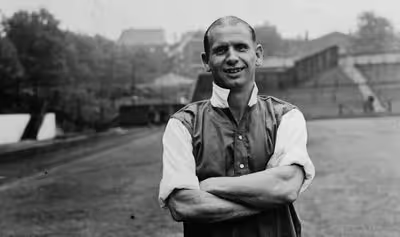
Their most vivid wartime moment came in 1943 when Reg Lewis’s four-goal haul helped Arsenal rout Charlton Athletic 7-1 at Wembley to win the southern section of the Football League War Cup.
Why those results matter
These victories offered morale for supporters and players alike and preserved Arsenal’s competitive culture through years of upheaval. Although wartime matches and goals were later excluded from official records, the performances shaped careers, kept the club visible and provided rare public rejoicing during a national crisis.
The human cost — nine Arsenal players killed in service
Arsenal’s wartime record is inseparable from loss. Nine registered players lost their lives while serving in the armed forces: Herbie Roberts, Bobby Daniel, Bill Dean, Cyril Tooze, Sidney Pugh, Harry Cook, William Parr, Leslie Lack and Hugh Glass. Their deaths — from combat, capture, torpedo attacks and wartime illness — robbed the club of talent and left a lasting absence beyond football statistics.
Notable cases and context
Herbie Roberts, a former defender, died in 1944 after serving with the Royal Fusiliers. Goalkeeper Bill Dean was lost when HMS Naiad was torpedoed in 1942. Teenage winger Bobby Daniel went missing over Berlin in 1943. Cyril Tooze, captured in Tunisia, was later killed in Italy. These stories underscore how the war reached into the heart of football clubs, turning familiar names into wartime casualties.
Careers altered — from stars to wartime roles
Not all Arsenal players were on battlefields, but many had their playing lives truncated or transformed. Cliff Bastin, exempt from conscription due to hearing problems, served as an Air Raid Precautions warden and retired in 1947, his record goals largely frozen by wartime exclusions.
Ted Drake, serving as an RAF physical training instructor, suffered a back injury that ended his playing career but later became a successful manager. Eddie Hapgood continued to appear in wartime fixtures while serving in the RAF before injuries prompted retirement. George Swindin served as a war reserve policeman and in the Territorial Army, later returning to be Arsenal’s postwar No.1 and, eventually, manager.
Long-term effects on player records and club history
Because wartime appearances and goals were not counted in official tallies, a generation of players have career totals that understate their contributions. The exclusion diminishes statistical legacies and complicates comparisons with peacetime peers, yet the impact of those wartime years remains culturally and emotionally significant for the club.
Legacy and what it means for Arsenal today
Arsenal’s wartime era is both pride and poignancy: success on makeshift pitches, trophies that lift spirits but sit outside official records, and the sacrifice of players who never returned. For modern supporters and historians, the period highlights the club’s resilience and raises questions about how football commemorates service and loss.
How clubs and fans can honor that history
Recognizing wartime contributions need not alter official stat books to be meaningful. Archive projects, memorials, museum exhibits and matchday acknowledgements keep those stories alive. For Arsenal, greater visibility for the wartime generation would bridge the gap between formal records and the lived history of the club.
Conclusion — a complex chapter in Arsenal’s story
Arsenal’s wartime record resists tidy categorization: genuine sporting achievement under extraordinary conditions, coupled with profound human sacrifice. The era shaped the club’s postwar trajectory, altered careers, and left a legacy that still influences how Arsenal remembers itself.
Why Arsenal's pursuit of Bruno Guimaraes makes tactical sense — and why Newcastle refuse to sell
Appreciating that complexity matters — not to rewrite official history, but to honor the players and understand how football endured through one of the century’s darkest moments.
 Yahoo! News


