


Breaking: Haris Tabakovic suffered a serious left-ankle injury in Borussia Mönchengladbach’s final-day clash with Hoffenheim, with initial assessments suggesting a likely fracture and potential surgery that could sideline him for 3–6 months — imperilling his Bosnia and Herzegovina World Cup place and complicating his loan/contract situation.
Tabakovic injury: immediate facts and impact
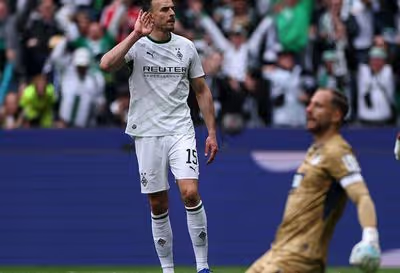
72 minutes into the match against Hoffenheim, Haris Tabakovic twisted his left ankle and was withdrawn immediately. Club and team staff have called for scans; early indications point to a significant injury that may require surgery and a multi-month rehabilitation.
This is a potential World Cup-level blow. If the 3–6 month timetable proves accurate, Tabakovic would almost certainly miss Bosnia and Herzegovina’s campaign — a loss of their in-form forward at the worst possible time.
What the clubs and national team are saying
Eugen Polanski, Gladbach’s manager, confirmed the substitution was injury-driven and voiced cautious hope that the damage wouldn’t be season-ending: “We had to take him off due to injury. We’re still hoping it isn’t too serious and that it doesn’t jeopardise his World Cup.”
Hoffenheim sporting director Andreas Schicker — whose club holds Tabakovic’s contract — praised the loan move to Gladbach and stressed the player’s value to both clubs. “He’ll be coming back now. We’ll see after the World Cup. Haris is a player who brings qualities we don’t currently have in the squad,” Schicker said, while noting contract considerations ahead of next season.
Season form that raises the stakes
Tabakovic arrived on loan and delivered the kind of output any club would prize: roughly 15 goals and three assists in 35 competitive appearances, plus four international qualifiers, including a crucial equaliser in a play-off draw with Italy.
That scoring return made him Gladbach’s talisman and Bosnia’s most reliable attacking option. Losing a forward in such form doesn’t just affect minutes and goals; it forces tactical rejigs for both club and country.
Why this matters for Gladbach and Bosnia
For Borussia Mönchengladbach, a club that has battled inconsistency, Tabakovic provided cutting edge and a proven goalscorer. His absence will expose gaps in attack and may accelerate transfer or tactical moves this summer.
For Bosnia and Herzegovina, the timing is brutal. A World Cup requires not just talent but depth; replacing a player who delivered key qualifiers is difficult in a short window. The coaching staff must consider alternatives and contingency plans swiftly.
Contract and transfer implications
Tabakovic remains a Hoffenheim player under contract until 2027 while on a one-year loan at Gladbach. That dual status complicates decisions: Hoffenheim must assess rehabilitation, Gladbach must evaluate attacking recruitment, and Tabakovic’s market value and transfer interest — reportedly present from other Bundesliga clubs — will hinge on the medical outcome.
Schicker’s comments underline the pragmatic stance Hoffenheim will take: evaluate fitness, then determine sporting plans ahead of a season when the forward enters the final year of his deal.
Outlook and next steps
Immediate priorities are medical confirmation and determining whether surgery is needed. If scans confirm a fracture and a 3–6 month recovery, Tabakovic’s World Cup hopes will be in serious jeopardy and both clubs will need to plan for his absence next season.
From an analytical perspective, this injury shifts several narratives: Gladbach must find a goals source or adjust tactics; Hoffenheim gains leverage in contract and squad planning; Bosnia must reshuffle its attack before a major tournament.
15 Best Footballers to Never Win a League Title (Ranked)
The swift release of scan results and a clear rehabilitation timetable will define decisions in the coming days.
 Yahoo! News


