


David Trunda, president of the Czech Football Association and a FIFA development committee member, has publicly endorsed OKC United, visiting Oklahoma City twice as the club unveiled its name and crest and confirmed a 2028 USL debut timed to the MAPS 4 stadium opening — a high-profile signal that the project aims to pair professional ambition with serious youth development and international best practices.
OKC United reveal: name, crest and a 2028 USL launch
OKC United officially unveiled its identity as the club prepares to enter the United Soccer League in 2028, aligned with the opening of the MAPS 4 downtown multi-purpose stadium.
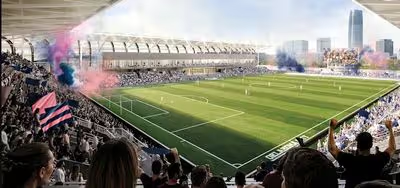
The announcement provided the first concrete visual and timeline cues for a franchise that has presented big ambitions beyond the pitch.
David Trunda’s visits add credibility and global connections
David Trunda — president of the Czech Football Association, a member of FIFA’s development committee and owner of top-flight Czech club FK Mladá Boleslav — has visited Oklahoma City twice in recent weeks.
His interest and public support are notable: Trunda praised the concept and local backing, calling the potential “enormous” and highlighting unusually broad community support from civic leaders to business stakeholders.
Trunda’s presence is more than ceremonial. As someone immersed in international football governance and youth development, his involvement signals a willingness to advise on infrastructure, academy models and operational standards that can accelerate OKC United’s growth.
Why his backing matters
An endorsement from a senior figure in European football gives OKC United instant credibility. It opens doors for knowledge transfer on coaching, scouting and academy design, and positions the club to attract partners and technical exchanges that smaller, start-up franchises often lack.
Trunda’s perspective also brings constructive caution: he’s rebuilding youth systems in the Czech Republic and stresses the importance of a strong grassroots base beneath any top-flight team. That emphasis could reshape OKC United’s priorities — making long-term youth development as visible as the pro team’s brand launch.
Sporting leadership and local ambition
Owner Christian Kanady and sporting director Sead Karaselimovic — a Bosnian-born executive with Sporting Kansas City experience — are positioning OKC United as a project that merges local investment with international best practice. Karaselimovic has described the opportunity to learn from global models, and Trunda’s visits have included stadium site tours, community stops and meetings with the club’s leadership.
Those connections suggest OKC United intends to build more than a roster: they plan a developmental pipeline, community integration and facility footprints that can sustain year-round programming.
Learning from established systems
Trunda warned against repeating past mistakes, noting that successful pro clubs require a deep “ground base” — youth teams, coaching education and infrastructure. That mirrors trends across elite football: sustainable clubs pair on-field ambition with robust academies and community pathways.
For Oklahoma City, that means the MAPS 4 stadium should be a focal point but not the whole plan. The real test will be whether the club invests in training centers, coaching pipelines and partnerships with local youth organizations.
What this means for Oklahoma City soccer
Short term: the Trunda endorsement amplifies media attention and helps recruit technical partners, coaches and potentially players who value structured development. It also validates the MAPS 4 timeline and the club’s stated ambition to be a regional hub.
Medium term: if OKC United follows through on academy commitments and leverages Trunda’s network, it could accelerate talent pathways and raise the standard of youth coaching across Oklahoma. That would make the club a credible route to professional soccer for local kids rather than just a ticketed entertainment product.
Long term: success hinges on execution. Building a sustainable club requires patient investment in scouting, coaching education and community ties. International contacts are a powerful advantage, but they must be matched by consistent local strategy and measurable development outcomes.
Next steps and likely milestones
Club leadership will need to publish operational plans detailing academy structure, coaching hires and facility timelines. Expect strategic announcements around technical partnerships or exchanges, academy leadership and youth programming in the months after the identity reveal. The MAPS 4 stadium opening in 2028 remains the anchor event; everything else should be measured by whether it creates a durable player development pathway beneath the pro team.
European federations threaten boycott as FIFA leak proposes selling World Cup stakes
In short, Trunda’s involvement is a meaningful vote of confidence. The real story going forward will be how OKC United turns international goodwill into concrete youth systems, coaching infrastructure and on-field results.
 Yahoo! News


