


Didier Deschamps stands on the brink of coaching immortality: if France topples Spain in New Jersey he would become only the second manager to lift the World Cup twice. A bold tactical remake — a high‑velocity attack anchored by Kylian Mbappé and a young quartet of Olise, Désiré Doué, Ousmane Dembélé and Bradley Barcola — has transformed Les Bleus from stodgy to scintillating, setting a decisive test of his managerial renaissance.
Deschamps’ renaissance: from underfire to contender for history
France entered this campaign bruised by criticism after a limp European exit and disruptive performances in Nations League fixtures. Deschamps responded not by clinging to past formulas but by actively remodelling the squad and its approach.
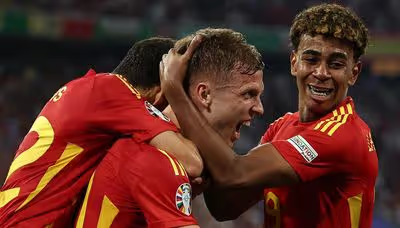
The result is a side that feels liberated rather than merely talented — quicker in transition, more varied in attack and willing to take calculated risks.
Tactical overhaul that changed the dynamic
Deschamps has shifted toward a more aggressive 4-2-3-1 that often looks like four forwards in action. This tweak sacrifices a traditional midfield presence but gains ruthless forward momentum and unpredictable combinations. The system was stress‑tested in a 5-4 thriller against Spain in Stuttgart and again in competitive fixtures where the offensive quartet produced moments of genuine excellence.
Why the change works
Freshwide players and creative midfielders now operate with clearer roles. The midfield is compact and purposeful, enabling quick vertical passes to Mbappé or the supporting attackers. That approach capitalizes on France’s depth of pace and one-on-one talent while masking transitional vulnerabilities with intensity.
Attackers to watch: Mbappé, Olise, Doué, Dembélé, Barcola
Kylian Mbappé remains the ultimate fulcrum — both scorer and orchestrator when opponents commit men forward. Michael Olise and Désiré Doué provide flair and penetration between the lines. Ousmane Dembélé’s trickery and Bradley Barcola’s energy offer rotation and tactical variety. Together they create mismatches that few teams can consistently handle.
How squad management has helped
Paris Saint-Germain’s rotation policy and a lighter domestic load for several key players have left Les Bleus unusually fresh. Younger internationals have been blooded deliberately, while the exit of long-serving veterans opened space for a coherent identity to form around the new core.
Leadership and legacy: what’s at stake for Deschamps
Deschamps entered this tournament under the weight of past criticisms — accused of pragmatism and over-reliance on individual brilliance. If France lifts the World Cup again, the narrative shifts: a coach who reinvented his team and won the ultimate prize across different player generations. Failure won’t erase the tactical progress, but victory would cement his status among the game’s elite.
The psychological edge
There is evidence Deschamps has become more engaged and accessible to his players, forging clear lines of communication. The visible bond with Mbappé — mutual trust and shared urgency — is as important as any tactical nuance in high-pressure matches.
Spain test: the clearest measure of France’s evolution
Spain brings technical fluency, youthful dynamism (Lamine Yamal remains a game-changer) and tactical cohesion. This match is a litmus test: can France’s high-octane front line break down a disciplined Spanish unit? A positive result would validate Deschamps’ gamble; a struggle would expose the remaining seams in the new system.
What to expect on the pitch
High-speed transitions and overloads down the flanks from France. Spain will probe possession, seeking to disorganize the French midfield and exploit spaces left by forward surges. Set-piece concentration and defensive discipline will likely determine fine margins.
Outlook: immediate and long-term implications
Short term: a win in New Jersey amplifies momentum and places Deschamps on the brink of historic achievement. Medium term: victory would hand the incoming era (a planned post-tournament transition) a clear inheritance — a remade, winning identity. Long term: success across distinct team cycles — a pragmatic title in one era and an attacking triumph in another — would be the best argument for Deschamps’ standing among all-time great managers.
Final take
This is more than a single match. It is the final exam for a coach who answered criticism with bold adaptation.
Pickford stresses discipline as England prepare to counter Messi in Argentina semi
France’s blend of youth, speed and tactical courage will either confirm Deschamps’ evolution into a truly transformative figure or expose the limitations of a high-risk plan under the brightest lights.
 Yahoo! News


