


Guéla and Desiré Doué's sibling saga has become the tournament's most compelling sub-plot: Guéla’s levelling strike helped Côte d’Ivoire upset France, while his younger brother Desiré sat wryly on the French bench. Their shared past at Rennes and the possibility of a World Cup rematch crystallise how personal narratives can reshape tactical focus and emotional stakes at this World Cup.
Doué brothers turn a friendly into a storyline that matters
Guéla Doué’s goal that levelled the score in Nantes did more than tilt a warm-up result — it highlighted a rare, human drama at the heart of elite international football. His older-brother status on Côte d’Ivoire and Desiré Doué’s place as an unused substitute for France created an image that will live long beyond the final whistle: a younger sibling smiling on the opposition bench as his brother celebrates.
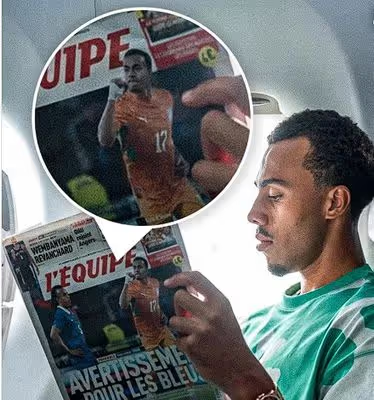
This is not just feelgood copy. The brothers’ shared upbringing — born to a French mother and Ivorian father, cut their teeth together at Rennes’ academy — and the fact Guéla once replaced a teenage Desiré on his Rennes debut are concrete reminders of how intertwined identity and national selection have become. If Côte d’Ivoire and France meet in the knockout rounds, the encounter will carry more than tactical consequence; it will be personal.
Why the Doué story matters to coaches and fans
Squads are assembled with data and scouting reports, but narratives like this can subtly influence selection dynamics. Managers must weigh media attention, player psychology and team unity. For France, the sight of a promising PSG talent watching his brother celebrate could complicate the handling of young stars. For Côte d’Ivoire, Guéla’s emergence is a proof point for their recruitment and development strategy.
Siblings are a broader tournament theme
This World Cup features an unusually high number of relatives on opposite or same squads, underscoring football’s globalised talent pathways. Notable pairings include:
Brian Brobbey (Netherlands) and his half-brother Derrick Luckassen (Ghana)
John Souttar (Scotland) and Harry Souttar (Australia)
Iñaki Williams (Ghana) and Nico Williams (Spain)
Lucas and Théo Hernández lining up for France
Laros and Deroy Duarte representing Cape Verde
Leandro Bacuna and Juninho Bacuna for Curaçao
One injury spared the tournament another entry: a Dutch twin would have added to the list had he not been ruled out. Historical precedent is thin — Jerome and Kevin‑Prince Boateng remain the only brothers to have played against each other at previous World Cups — so these pairings add novelty and narrative weight.
What sibling match-ups mean tactically
Beyond headlines, sibling ties can be leveraged or mitigated. Opponents may try to unsettle a player with reminders of family ties, or conversely use them to diffuse pressure. Coaches who understand the psychological subtext will gain an edge — the game is as much about managing human variables as it is about formations.
Warm-up results and on-field form
Argentina opened their defence in encouraging fashion, with Lionel Messi converting a penalty in a 3-0 victory over Iceland; Valentín Barco and Thiago Almada also scored. England kept momentum with a comfortable 2-0 win over Costa Rica in their final preparations. Mixed results elsewhere: Senegal drew with Saudi Arabia, while Venezuela beat Iraq in a surprise result in Illinois.
These friendlies aren’t definitive but they matter for rhythm and injury management. Teams that find coherence now can carry confidence into group play; those that tinker without clarity risk entering the first whistle undercooked.
Player fitness and squad management
Managers are openly discussing load management. A notable example: Bukayo Saka is reportedly carrying discomfort and will need careful minutes to remain effective across a long tournament. How teams manage key attackers — whether to protect them in group matches or push for momentum — will be a defining managerial test.
Off-field stories shaping the tournament atmosphere
Security and politics are colliding with football. A referee from Somalia, poised to become the nation’s first at a World Cup, was denied entry to the United States after authorities cited alleged links to suspect individuals. The decision prompted a wave of support at home and renewed debate about how political decisions intersect with global sport.
In Mexico City, protests briefly disrupted access to the Azteca Stadium in the days before the event, a reminder that major tournaments sit inside broader civic and political landscapes. Clubs and governing bodies must be prepared for disruptions that have nothing to do with matchday tactics.
Club controversies and transfer noise
Off-field matters at club level continue to ripple: restrictions remain in place around certain club directors following safeguarding investigations, and elite transfers still dominate the headlines as clubs jockey for high-profile additions. These stories affect players’ mental states and can shape managerial planning for national teams.
Smaller items of note
- A chaotic friendly in Fortaleza saw tensions boil over in a high-profile women’s match that left the home side flustered.
- Domestic managerial moves and transfer bids continue to excite speculation, with several big clubs active in the market.
- A few national setups have faced administrative and selection headaches that could influence their group-stage outlook.
What to watch next
The Doué brothers’ arc offers the clearest microcosm of this tournament’s human drama. Keep an eye on potential France–Côte d’Ivoire fixtures for how narrative bleeds into tactics. Meanwhile, monitor squad management decisions around key attackers and any off-field disruptions that could upend planning.
Ranked! The 100 best football players of all time
This World Cup will be decided by form, fitness and moments — but also by the stories that bind players and nations. The tournament’s richer when those stories are understood, not just consumed.
 Yahoo! News


