
Haiti have parted company with coach Sébastien Migné after guiding the nation to its first World Cup finals since 1974 — a historic qualification that ended in a Group C exit against Brazil, Morocco and Scotland. The Haitian federation described Migné’s departure as an "amicable agreement", closing a chapter defined by progress on the pitch and unanswered questions off it.
Haiti part ways with coach Sébastien Migné after World Cup campaign
Haiti and French coach Sébastien Migné have agreed to separate after the Caribbean side's return to the World Cup spotlight.
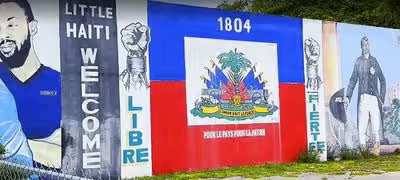
Federation statements framed the split as amicable, but the timing — immediately after a high-profile tournament appearance — underscores competing expectations between short-term achievement and long-term project-building.
Key facts: World Cup performance and exit
Haiti reached the World Cup finals for the first time since 1974, drawn into a demanding Group C alongside Brazil, Morocco and Scotland.The team exited at the group stage, eliminated on head-to-head tiebreakers after the first two matches rather than goal difference — a technicality that highlights both the fine margins of tournament football and Haiti’s inability to convert competitiveness into progression.
Haiti produced one of the tournament's most dramatic moments when they twice led Morocco before succumbing to a 4-2 defeat.That game showcased offensive ambition and moments of genuine quality, but also exposed defensive frailties that opponents of higher calibre punished.
Migné’s tenure: credentials and accomplishments
Sébastien Migné arrived with a résumé that included national-team spells with Congo, Kenya and Equatorial Guinea.He steered Haiti through qualifying and delivered the rare achievement of World Cup qualification — a milestone that resets expectations for players and administrators alike.
As coach, Migné instilled attacking intent and tactical flexibility, getting the best out of a squad that had limited resources compared to footballing powerhouses.Those gains, however, sat alongside structural weaknesses: depth, defensive organisation and a domestic infrastructure that makes sustained progress difficult.
What the departure means for Haitian football
The federation’s language of an "amicable agreement" smooths the public narrative, but the decision points to an inflection moment.Qualifying for the finals raises the bar — stakeholders will assess whether Migné’s methods offer a platform for long-term development or whether fresh leadership is required to professionalise the pathway from youth to senior level.
For players, the exit introduces uncertainty but also opportunity: new coaching brings different systems and selection debates, while the exposure of the World Cup can accelerate transfers and investment.For the federation, the challenge is practical — convert World Cup attention into sustained improvement in coaching, scouting and domestic competition.
What comes next: priorities for Haiti’s FA
Immediate priorities are clear: appoint a successor capable of consolidating the recent momentum, shore up defensive weaknesses exposed at the finals, and create a coherent plan for youth development and CONCACAF competition.That plan should balance short-term results with building depth, so Haiti can remain competitive in regional qualifiers and avoid cyclical peaks followed by regressions.
Rooney: Harry Kane's movement can unlock Argentina's Martínez and Romero in semi-final
Any incoming coach will inherit a team with proven attacking instincts and greater international visibility. The real test will be turning that visibility into institutional gains that prevent Haiti’s next World Cup run from becoming an outlier rather than the start of a new era.
 Yahoo! News