Giovanni Malagò has formally confirmed he will file his candidacy for the FIGC presidency tomorrow after securing Lega Serie B’s endorsement, adding to existing support from Lega Serie A, the players’ and coaches’ associations and positioning him as the favourite to command a majority in the imminent federation vote.
Malagò confirms FIGC bid after clinching key endorsements
Giovanni Malagò told guests at a high-profile dinner that he will file his candidacy for the presidency of the Italian Football Federation (FIGC) tomorrow. The former CONI chief and head of the Milano‑Cortina 2026 organising committee arrives at the race with the backing of Lega Serie A, Lega Serie B, the players’ association and the coaches’ association, a coalition that places him on course for a clear majority of electoral votes.
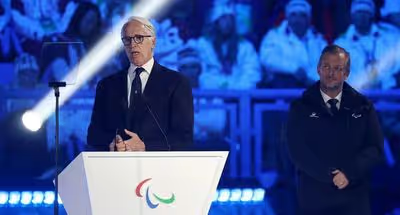
Why Lega Serie B’s support matters
Lega Serie B’s endorsement removes a major obstacle to Malagò’s path to the presidency. With both professional leagues and the players and coaches aligned behind him, he now controls the institutional muscle that typically decides federation leadership. That alignment reduces the likelihood of a fractured vote and forces other contenders to build broad cross‑sector alliances.
Electoral arithmetic: delegates and leverage
Below is the delegate breakdown that will determine the upcoming FIGC election:
Delegate share
Lega Serie A: 20 delegates — 18% of votes
Lega Serie B: 20 delegates — 6% of votes
Lega Pro (Serie C): 57 delegates — 12% of votes
LND (Amateur Leagues): 99 delegates — 34% of votes
Players’ association: 52 delegates — 20% of votes
Coaches’ association: 26 delegates — 10% of votes
Those figures underline a central tension: while the professional game and players/coaches can cobble together a winning majority, the LND (amateur leagues) and Serie C hold a sizeable independent bloc. Securing or neutralising those votes will be crucial to consolidate authority and legitimacy.
Context: why the FIGC presidency is open
The FIGC vacuum followed Gabriele Gravina’s resignation after Italy failed to qualify for the 2026 World Cup. That failure forced an institutional reckoning — the federation needs not only a leader but a clear roadmap to rebuild the national team and restore credibility across the pyramid. Malagò brings administrative gravitas from his time at CONI and the Olympics organising committee, though his football‑specific record is thinner than some rivals'.
Giancarlo Abete and the competitive field
Giancarlo Abete remains the other prominent candidate. The race will test whether sporting administrators prefer a technocrat with multisport governance experience or a figure with deeper rooted football network ties. Endorsements from the professional leagues and unions have given Malagò an early edge; Abete will need to sway the significant amateur and lower‑league contingents to contest that advantage.
What Malagò’s presidency would mean for Italian football
An incoming Malagò administration would likely prioritise governance reform, infrastructure delivery and rebuilding Italy’s international standing — areas aligned with his Olympic background. That pragmatic, managerial approach could accelerate organisational stability but risks friction with the grassroots and lower‑league stakeholders focused on funding, promotion and development pathways. Bridging those priorities will be the immediate governance challenge.
Immediate next steps and outlook
Malagò’s formal filing triggers the official electoral clock: campaigning, delegate negotiations and the federation vote. The crucial battlegrounds will be Serie C and the LND, where local and amateur interests could leverage concessions in return for support. If Malagò secures the presidency, his first tests will be a transparent strategic plan for the national teams, coach education and a credible engagement strategy with the amateur game.
Bottom line
This is a pivotal moment for Italian football governance.
Lionel Messi's MLS pay climbs again as Inter Miami star widens gap atop salary rankings
Malagò’s coalition of professional leagues and unions makes him the frontrunner, but lasting authority will depend on his ability to unite the full spectrum of Italy’s football ecosystem — from Serie A boardrooms to amateur clubs that represent the sport’s grassroots.
 Yahoo! News