


US Soccer confronts a pressing leadership reset as Mauricio Pochettino’s contract lapses with the World Cup’s end and sporting director Matt Crocker departed months ago. CEO JT Batson and COO Dan Helfrich insist a deep internal bench will bridge gaps, but the federation must act fast to lock down coaching and sporting structure to preserve momentum for the men’s national team and youth pipeline.
Immediate fallout: Pochettino’s future and a vacant sporting director seat
Mauricio Pochettino’s contract runs out with the World Cup, leaving the men’s national team without a confirmed head coach at a pivotal moment. Earlier this year Matt Crocker resigned as sporting director, and that vacancy remains a conspicuous gap in the organization’s chain of command.
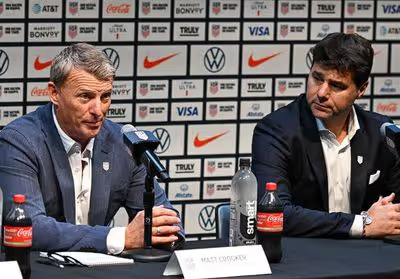
JT Batson said the federation will “take a break after the World Cup and rest and recuperate,” but stressed that discussions with Pochettino and his staff have already focused on long-term planning. Those conversations included coordination around the U23 setup with Steve Cherundolo, highlighting that planning hasn’t stopped despite contractual uncertainty.
Federation response: collective leadership over a single figure
Batson pointed to a federation workforce of over 600 people as evidence the organization is not reliant on one executive to steer strategy. COO Dan Helfrich emphasized a collaborative approach, naming figures involved in planning: Oguchi Onyewu, Barry Pauwels, Tracey Kevins and Emma Hayes. Helfrich forecasted “a little more clarity on structure” in the months to come while asserting that “the fundamentals of the team are there.”
What this means for the USMNT and player development
The absence of an immediate decision on Pochettino — and no appointed sporting director — introduces short-term uncertainty for tactical continuity, squad selection frameworks and development pathways. That uncertainty matters because the next 18 months will be critical for integrating younger players ahead of major competitions and capitalizing on the momentum and learnings from this World Cup cycle.
At the same time, active involvement from seasoned soccer figures inside the federation can preserve continuity. Having experienced operatives engaged in near-term choices reduces the risk of abrupt philosophical swings, but it does not replace the clarity a permanent technical leadership structure provides.
Why timing is consequential
Key planning windows for scouting, coaching hires, and youth-program alignment are already open. Prolonged indecision could complicate recruitment and tactical planning for Olympic-eligible squads and the run-up to the next World Cup cycle. Conversely, a prompt, transparent process would stabilize the environment and help retain coaching talent and player buy-in.
Analysis: prudent delegation, but pressure to formalize roles
US Soccer’s public assurance of a deep bench is strategically sensible: it signals stability without rushing a headline-grabbing hire. Yet reliance on an ad hoc leadership cohort risks dragging out structural questions that affect long-term competitiveness. The federation’s credibility will hinge on translating broad promises into a clear roadmap and timelines.
This moment is a test of executive governance as much as soccer strategy. If the federation can convert its internal expertise into decisive hires and transparent reporting lines, the team should emerge stronger. If not, lingering ambiguity could erode planning efficiency during a critical development phase.
What to watch next
Watch for: a formal decision on Pochettino’s contract; announcements about any sporting director or restructured leadership roles; clarity on U23 and youth-development responsibilities; and the federation’s timeline for public updates.
Those moves will determine whether this is a temporary shuffle or the start of a substantive organizational redesign.
 Yahoo! News


