


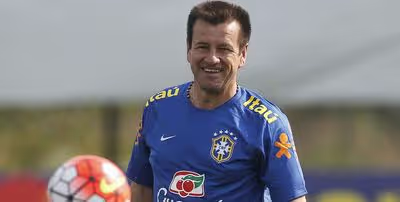
Former Brazil captain Dunga and teammate Bebeto say the United States match at Stanford Stadium was the Selecão’s toughest test in the 1994 World Cup — a 1–0 knockout that, despite Brazil advancing, validated America’s tactical grit and helped accelerate U.S. soccer’s professional evolution toward MLS and 2026 ambitions.
Why Brazil still names the USA as their toughest test from 1994
Dunga’s blunt assessment—“That was probably the hardest game that Brazil played during that World Cup”—reframes a classic narrative. Brazil won 1–0, but the context matters: a packed Stanford Stadium, a physical, disciplined U.S. side and a late red card that forced Brazil to finish the match with 10 men. That combination turned a supposed mismatch into a genuine tactical battle.
The match in short: Stanford Stadium, Leonardo’s red card, Bebeto’s winner
Brazil dominated possession early but missed clear chances, growing increasingly frustrated. Leonardo’s dismissal just before halftime left the Selecão a man down for the second half. Brazil absorbed pressure and finally broke through in the 72nd minute when Bebeto scored the decisive goal. The final score masked how uncomfortable the favorites were throughout large stretches.
How the U.S. made life difficult for the Selecão
The American approach blended physicality, compact defending and sustained belief. Marcelo Balboa and his teammates were not simply trying to survive; they were organized, relentless and comfortable with incremental defending that forced Brazil into low-percentage situations.
Crowd energy at Stanford amplified that plan. In tactical terms, the U.S. exploited set-piece moments and disrupted Brazil’s rhythm—exactly the recipe that frustrates flair-driven teams.
Legacy: why the game mattered beyond a single knockout match
The U.S. performance did more than boost national pride. It exposed American soccer’s readiness to compete on the world stage and helped build momentum for structural change. Two years later MLS launched; youth academies and scouting networks expanded; American players increasingly moved to Europe. The match served as validation that tactical discipline and collective preparation could narrow talent gaps.
From 1994 to 2026: a direct line
That July afternoon helped shift expectations. The U.S. went from transient World Cup participants to a nation investing in infrastructure and player development. Marcelo Balboa’s refrain—“We laid a great foundation”—captures the practical outcome: clubs, agents and European teams began scouting U.S. talent more seriously. Co-hosting the 2026 World Cup now places fresh pressure and opportunity on a federation built on that foundation.
What this means for Brazil, the U.S. and future tournaments
For Brazil, the anecdote is a reminder that even the most decorated teams can be tested by organization and intensity. For the U.S., the match is historical proof that belief and structure create competitive edges. Looking forward, teams that marry technical quality with tactical discipline will be best positioned at global tournaments—an evolution both nations have had to manage in different ways.
Conclusion: the match as a turning point, not an upset
The 1–0 scoreline understates the match’s significance. It wasn’t merely a near-upset; it was a statement of trajectory for U.S. soccer and a cautionary tale for favorites reliant on flair.
When Brazil’s 1994 legends still single out that game, they’re acknowledging a moment that helped reshape the international landscape and set the United States on a roadmap to 2026.
 Yahoo! News


