


North America’s 2026 World Cup looms as a collision of established powerhouses and fresh challengers: France’s electric attack remains the benchmark, England under Thomas Tuchel look like an improved dark horse, and multiple debutants — Curacao, Uzbekistan, Cape Verde — add unpredictability. Injury doubts, managerial tweaks and depth in midfield will decide who survives a brutal, expanded 48‑team format.
Tournament snapshot: what to watch at the World Cup in the US, Mexico and Canada
Big-picture themes
France arrive with the deepest attacking talent, but Didier Deschamps’ pragmatic instincts could blunt their flair. England’s Thomas Tuchel has tightened structure and added tactical nuance — how that translates under tournament pressure is the key storyline.
The expanded 48-team format amplifies opportunity for smaller nations to spring shocks, while fitness and squad depth will separate contenders from pretenders in sweltering North American conditions.
Group A
Mexico — expectations and limitations
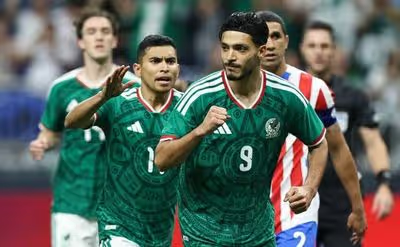
Mexico are at home and under pressure to perform, but injuries to Santiago Giménez and Edson Álvarez plus a lack of attacking cohesion leave Javier Aguirre’s side short of a genuine deep run. A pragmatic 4-3-3 conceals creative shortcomings; home support may be decisive to reach the second stage.
South Africa — promise, not yet punch
Hugo Broos’ side showed possession dominance in recent tournaments but struggled to convert control into goals. Lyle Foster leads the line; finishing will determine if they can be more than a good story in the group stage.
Czech Republic — direct, physical and compact
Patrik Schick remains the focal point in a practical system likely to prioritise set-pieces and aerial strength. A back-three with wing-backs gives them solidity; expect them to target progress as one of the best third‑placed teams.
South Korea — Son’s influence and tactical flexibility
Son Heung‑min’s status remains central even as coaches juggle 3‑4‑3 and 4‑3‑3 options to free Lee Kang‑in and Hwang Hee‑chan. Their experience in Europe gives them a realistic shot at the knockout rounds.
Group B
Canada — home hopes hinge on fitness
Alphonso Davies’ availability is the headline; without him Jesse Marsch leans on Jonathan David’s goals. Marsch’s high‑energy, press‑based approach demands buy‑in and conditioning — if it clicks, Canada can escape a soft group.
Bosnia and Herzegovina — veteran leadership
Edin Džeko still provides the finishing touch and leadership, while Serbia-style tactical discipline makes them hard to break down. Group progress would be a significant achievement.
Qatar — containment strategy
Julen Lopetegui’s plan will be containment and compact defending. Akram Afif supplies moments of quality but Qatar are likely to struggle against higher‑intensity opponents.
Switzerland — structured and dependable
Granit Xhaka is the axis in a possession-based, methodical side under Murat Yakin. Switzerland’s discipline often carries them into last‑16 territory, but they lack elite firepower to go much further.
Group C
Brazil — balance of genius and pragmatism
Vinícius Jr is the X‑factor in Carlo Ancelotti’s flexible attacking setup. Ancelotti’s management of egos and combinations will dictate Brazil’s title tilt; defensive full‑back depth is the only tangible concern.
Morocco — athleticism and cohesion
Achraf Hakimi’s energy and Brahim Díaz’s creativity make Morocco a compact, technically gifted side. A fresh coach brings questions, but their tournament experience keeps them dangerous.
Haiti — brave underdogs
Haiti’s selection mix of domestic and diaspora talent offers raw moments but they lack consistency and depth. Any points would be historic.
Scotland — counter‑punch with set‑piece quality
Steve Clarke’s side will rely on width and late midfield runs from Scott McTominay. They may cede possession but can be disruptive enough to contest third‑place spots.
Group D
United States — hosts with expectations
Mauricio Pochettino’s shift to 3‑4‑3 and a more measured press centers the build‑up on Folarin Balogun and Christian Pulisic when fit. Home crowds are an asset; the question is whether tactical conservatism limits their upside.
Paraguay — defensive steel
Omar Alderete anchors a pragmatic Paraguay that thrives on low‑scoring margins. Their path looks to be tight, disciplined games rather than open affairs.
Australia — structured, limited cutting edge
Tony Popovic’s back‑five approach provides defensive security but lacks a marquee attacking presence to change games consistently. Progression would be a bonus.
Turkey — youthful creativity
Arda Güler and Kenan Yıldız inject spark; Vincenzo Montella’s system aims to marry defensive solidity with wing‑back width. If they balance that, Turkey can advance.
Group E
Germany — tactical inventiveness under Nagelsmann
Jamal Musiala and Florian Wirtz offer a smooth creative spine. Nagelsmann’s tactical flexibility is an asset, but defensive lapses and midfield transition after Kroos and Gündoğan remain concerns.
Curaçao — Dutch schooling, modest ambitions
Juninho Bacuna typifies Curaçao’s technical approach shaped by the Dutch system. Participation alone is a milestone; a goal would be celebrated as a major success.
Ivory Coast — midfield strength, forward questions
Ibrahim Sangaré and Franck Kessié provide midfield bite; Yan Diomandé is emerging as an attacking star. If their frontline gels, they’re a credible last‑32 contender.
Ecuador — altitude‑hardened defence
Moisés Caicedo leads a combative midfield shielding a resilient defence built on Piero Hincapié and Willian Pacho. Lack of consistent attackers could blunt progression ambitions.
Group F
Netherlands — balance of possession and defensive riches
Frenkie de Jong drives their midfield; Ronald Koeman’s selection headache is a forward who can match his back‑line quality. Strong on paper, their ceiling depends on finishing.
Japan — fluid attack and disciplined press
Ayase Ueda’s finishing and Kaoru Mitoma’s wing play make Japan one of the most cohesive unit in transition. Hajime Moriyasu’s men are bankable for the knockout phase.
Sweden — two varied striking options
Alexander Isak provides individual brilliance; Graham Potter’s tactical rotations could unlock a dual‑striker system. Sweden’s qualifying form was patchy, so consistency is the issue.
Tunisia — compact and conservative
Sabri Lamouchi favours organisation over risk. Ellyes Skhiri offers midfield stability; Tunisia will aim to frustrate attackers rather than outplay them.
Group G
Belgium — post‑golden‑generation rebuild
Jeremy Doku’s dribbling is the main dash of unpredictability in a side transitioning from a past golden era. Attacking depth exists, defensive frailties and squad cohesion may be limiting factors.
Egypt — Salah’s last hurrah as focal point
Mohamed Salah remains the talisman and Egypt will look to channel their attack through him. A compact defensive setup offers a practical route to the last 16.
Iran — resilient, politically sensitive
Mehdi Taremi is a reliable scorer and Iran’s conservative approach frustrates opponents. External circumstances could overshadow their on‑pitch campaign; performance-wise they’ll be hard to dismiss.
New Zealand — Wood’s leadership
Chris Wood is the central threat but New Zealand’s limited offensive output makes progression a long shot. Discipline and organisation are their strengths.
Group H
Spain — possession with cutting edge
Lamine Yamal and Rodri give Spain both invention and control. Luis de la Fuente’s side are tournament favourites on form and depth, with the climate and tactical nous a likely advantage.
Cape Verde — compact, front‑footed
Dailon Livramento is a bright attacking talent; Cape Verde’s brave, proactive style makes them an entertaining underdog. Realistic goals: competitiveness and pride.
Saudi Arabia — organized and defensive
Salem Al‑Dawsari leads a side built on collective compactness. Facing Spain and Uruguay is daunting; solidity will be their best hope.
Uruguay — Bielsa’s intensity, ageing firepower
Federico Valverde and Darwin Núñez provide dynamism, but Uruguay lack the prolific strike force of past eras. Bielsa’s demanding style ensures they will be competitive in every match.
Group I
France — the benchmark attack
Kylian Mbappé headlines a fearsome forward bank; Deschamps must balance prudence with letting attacking stars roam. Depth makes France favorites, though subtle tactical conservatism could cap their entertainment value.
Senegal — African heavyweight
Sadio Mané and Nicolas Jackson combine experience with modern athleticism. Senegal possess the balance to progress deep if their midfield control holds.
Iraq — long-awaited return
Aymen Hussein’s goals were crucial in qualification; Graham Arnold’s side are underdogs who will lean on direct play and grit. Expect spirited displays rather than results.
Norway — Haaland’s arrival on the big stage
Erling Haaland elevates Norway’s ceiling instantly; Martin Ødegaard’s supply is a natural fit. Group difficulty is high, but Norway have the offensive firepower to trouble anyone.
Group J
Argentina — Messi’s swansong, collective quality
Lionel Messi’s final World Cup status is narrative gold; Julían Álvarez’s energy and midfield balance from Alexis Mac Allister matter equally. Defence depth and Cristiano Romero’s fitness are pivotal.
Algeria — dynamic attackers, uneven consistency
Riyad Mahrez and Rayan Aït‑Nouri combine leadership and dynamism; Algeria’s mix of flair and structure could be enough to sneak through as a third‑place qualifier.
Austria — Rangnick’s systemised side
David Alaba’s leadership and Konrad Laimer’s engine typify an organised, pressing unit. Austria’s cohesion makes them awkward opponents, though they lack elite stars.
Jordan — spirited qualifiers
Mousa Al‑Tamari brings the technical spark. Jordan’s 3‑4‑3 counters and resilience can cause problems, but progression remains unlikely.
Group K
Portugal — midfield powerhouse
Bruno Fernandes, Bernardo Silva, Vitinha and João Neves create a midfield of rare depth; Cristiano Ronaldo’s presence is symbolic and tactical. Roberto Martínez must channel midfield riches into consistent forward output.
DR Congo — defensive solidity, quick transitions
Yoane Wissa and Chancel Mbemba give both threat and organisation. Expect a tight, counter‑attacking approach aiming for best third‑place routes.
DR Congo vs Portugal — tactical clash
Portugal’s possession versus Congo’s physical transitions will be a classic mismatch of styles; execution will decide the outcome more than identity.
Uzbekistan — debutants with Italian coaching
Fabio Cannavaro’s influence and Manchester City’s young Abdukodir Khusanov add intrigue, but Uzbekistan face a steep quality gap. Experience at this level will be invaluable for future cycles.
Group L
Colombia — Luis Díaz’s responsibility
Luis Díaz’s form is central to Colombia’s attacking threat; James Rodríguez remains a creative fulcrum. They’re built for open games and should be competitive in South American style.
England — Tuchel’s structural upgrade
Harry Kane remains the tournament’s premier striker and Thomas Tuchel’s tactical discipline could push England deep. Midfield balance and coping with heat will determine whether they convert talent into silverware.
Croatia — aging core, organised possession
Luka Modrić’s longevity is a paradoxical strength and vulnerability; Josko Gvardiol’s versatility energises the backline. They’ll pose tactical problems but may lack the teeth for a surprise title run.
Ghana — coaching reset, mixed form
Carlos Queiroz brings experience and a defensive reset. Antoine Semenyo’s versatility threatens defenders, but recent instability places Ghana’s progression in doubt.
What this all means and likely knockout picture
Depth in midfield and forward areas separates genuine contenders from pretenders. France, Brazil, Spain and Portugal possess the blend of creativity and squad breadth to go deep; England and Argentina have the star power and tactical frameworks to be serious threats. Dark horses with structures to cause upsets include Morocco, Senegal and the Netherlands if finishing improves. The expanded format increases variance — expect surprises, and a few small nations to rewrite expectations.
Final note: fitness, form and managerial decisions will decide it
In a condensed summer schedule and a taxing climate, rotation and medical management are as decisive as formations. Managers who pair clear identity with pragmatic squad rotation — Ancelotti, Nagelsmann, Tuchel — hold an edge.
Argentina World Cup 2026 guide: Fixtures, prediction, key player and odds
For fans, this World Cup promises attacking fireworks and tactical intrigues in equal measure.
 Yahoo! News


