
Philadelphia Union 16-year-old Cavan Sullivan became the first professional to wear Adidas' 3D-printed football boots during the club's MLS meeting with the New York Red Bulls, debuting a bespoke Project RAP pair that carries his US, Bangladesh and Germany heritage flags.
Cavan Sullivan debuts Adidas 3D-printed boots in MLS
Cavan Sullivan, the Philadelphia Union teenager and United States youth international, wore Adidas' new 3D-printed boots in the club's MLS match against the New York Red Bulls.
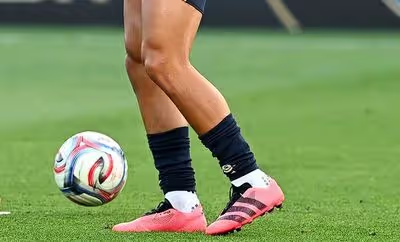
The pink-and-black pair is the first of its kind used in a professional match, produced through Adidas' Project RAP to match Sullivan's foot shape and biomechanics.
What happened on the pitch
Sullivan, 16, started in midfield and ran out in a custom-built boot engineered to his specifications. The design includes the flags of the United States, Bangladesh and Germany on the upper — a personal touch that underscores the bespoke nature of the technology as much as its visual appeal.
What are Adidas' 3D-printed boots and Project RAP?
Adidas' Project RAP (Radical Athlete Perception) combines foot-scanning, biomechanical data and additive manufacturing to produce boots tailored to an individual player's anatomy and movement patterns. 3D printing allows for precise customization of fit, structure and material density in key zones, aiming to reduce pressure points and improve comfort.
Why this matters — for the player, the club and boot technology
For Sullivan, the boot is both a performance tool and a statement: a custom fit can aid a young player's development by enhancing comfort and confidence on the ball. For the Union and MLS, the debut signals the league's growing role as a testing ground for innovation in elite football equipment.
For Adidas, putting 3D-printed boots into a competitive match is a strategic step toward normalization of bespoke footwear. If the technology proves durable and beneficial, it could accelerate a shift from off-the-shelf models to personalized gear across professional squads.
Practical limits and the path to wider adoption
3D-printed boots face logistical hurdles: production time, cost, testing for durability and regulatory approval for match play. Widespread adoption will depend on scaling manufacturing, demonstrating injury-reduction or performance gains, and convincing clubs that the extra investment is worth the return.
What to watch next
Expect scrutiny: analysts and rivals will watch how the boots hold up across a full season and whether customized footwear influences availability or form. Sullivan's on-field performances will shape the narrative — if he thrives, the story becomes about technology enabling talent; if not, the boots will be treated as an intriguing experiment rather than a revolution.
Bottom line
Cavan Sullivan's appearance in Adidas' 3D-printed boots is a milestone for equipment innovation in MLS and professional football.
Post-World Cup MLS: Griezmann, Casemiro and Lewandowski Shift the Balance
It highlights how individualized technology is moving from lab to matchday, and it raises clear questions about cost, scalability and the real-world benefits for player performance.
 Yardbarker