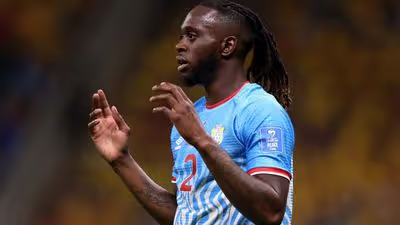
England face DR Congo in a World Cup Round of 32 clash at Mercedes‑Benz Stadium, Atlanta, on Wednesday, July 1 — a meeting that pits heavy favourites against a DR Congo side rebuilt through a targeted European recruitment drive that brought Aaron Wan‑Bissaka and Axel Tuanzebe into the fold. This match will test whether DR Congo’s scouting strategy can translate into knockout-stage resilience and whether Wan‑Bissaka musters the revenge narrative he once sought with England.
England vs DR Congo: World Cup Round of 32 — quick take
England arrive as clear favourites, but DR Congo’s path to Atlanta is a story of deliberate talent reclamation. The Congolese side, coached by Sébastien Desabre, topped Group L and now face England in what is a high-stakes, high-contrast knockout tie.
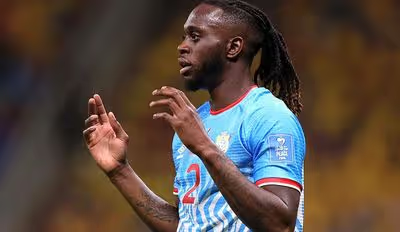
For England it’s routine progression; for DR Congo it is the validation of an aggressive recruitment model targeting players raised in Europe.
Match details and immediate context
Kick-off: Wednesday, July 1, Mercedes‑Benz Stadium, Atlanta. Competition: FIFA World Cup Round of 32. Stakes: England look to assert tournament control; DR Congo seek to upset an established heavyweight and prove their newly assembled squad can deliver on the big stage.
How DR Congo rebuilt: the recruitment that changed everything
DR Congo’s resurgence is less a fluke than a blueprint. A concerted effort to identify and persuade dual-national players — many developed in European academies — has moved the nation from occasional participant to genuine knockout contender. The recruitment operation combined scouting databases, personal outreach and the promise of central roles at major tournaments to flip the allegiance of players who might otherwise be fringe options for European national teams.
This strategy brought in established professionals rather than developmental prospects, prioritising immediate impact. The result is a side that mixes Premier League-hardened defenders with forwards accustomed to top-flight pressure — a roster designed to weather knockout intensity.
Key signings and why they matter
Aaron Wan‑Bissaka — A right-back with Premier League pedigree, Wan‑Bissaka brings defensive solidity and pace. His decision to switch allegiances provides DR Congo with international-class experience at full-back, something most African nations struggle to assemble.
Axel Tuanzebe — A centre-back who has delivered crucial moments, including a decisive goal in qualification extra time. His presence stabilises the backline and offers leadership born of years in English football.
Noah Sadiki and Yannick Bolasie — Younger and more dynamic options, they add balance and the capacity to influence tempo. Collectively, these recruits reshape DR Congo’s tactical identity: compact defensively, swift and direct in attack.
Aaron Wan‑Bissaka: personal arc and tactical fit
Wan‑Bissaka’s club CV is familiar: a Crystal Palace academy graduate, a big-money move to Manchester United in 2019, and domestic cup honours before a later transfer to West Ham. Internationally, he flirted with England recognition but never secured a senior cap amid fierce competition at right-back. FIFA’s approval of his switch in August 2025 closed the chapter on an England pursuit and opened a starring role for DR Congo.
Tactically, Wan‑Bissaka offers discipline at right-back and the ability to nullify England’s wide threats. His inclusion changes DR Congo from a wildcard into a tactically credible side capable of absorbing pressure and exploiting turnovers.
Attacking threats: Yoane Wissa and the forward line
Yoane Wissa has been DR Congo’s most consistent attacking outlet, carrying scoring responsibility through the group stage. Paired with direct runners and players experienced in high-tempo leagues, Wissa gives Desabre a realistic plan to punish defensive lapses and counter England’s more possession-oriented approach.
Why this tie matters beyond one game
For DR Congo, progress past England would validate their recruitment blueprint and reshape how other nations approach dual-national outreach. For England, a win avoids an embarrassing exit and preserves momentum in a tournament where expectations are sky-high. For Wan‑Bissaka personally, the game is a satisfying coda to a long international odyssey — and a test of whether club form translates to decisive World Cup performances.
This match also highlights modern national-team building: histories and borders no longer dictate squads as much as scouting sophistication and personal persuasion.
What to watch and likely scenarios
Defensive discipline: Can England break down a compact DR Congo without overcommitting? Transition moments: DR Congo’s best route is quick counters exploiting space behind England’s full-backs. Set pieces and details: Tight knockout games often hinge on organisation and composure in the 18‑yard box.
If DR Congo execute their game plan and force turnovers, they stand a credible chance of unsettling England. Conversely, if England impose tempo and exploit individual quality, the tie should tilt back to the favourites.
Bottom line
This is more than a Round-of-32 fixture: it is a litmus test for DR Congo’s strategic overhaul and a pressure point for England’s tournament narrative.
World Cup benching exposes doubts over Barcelona's £69m gamble on Anthony Gordon
The outcome will speak to the power of modern recruitment and the thin margins that separate established powers from emerging dark horses at a World Cup.
 Yardbarker