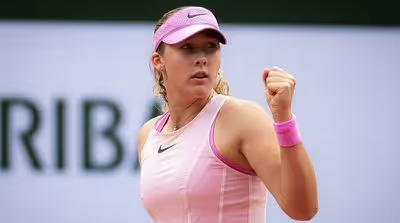
Mirra Andreeva stormed into her first Grand Slam final at Roland Garros, dismantling Marta Kostyuk 6-1 6-3 in 76 minutes to end Kostyuk’s perfect clay run and reverse their season narrative. The 19-year-old’s composure, aggression and freshness proved decisive amid an emotionally charged semi-final that also highlighted the off-court tensions surrounding the Ukrainian player.
Andreeva overwhelms Kostyuk to reach maiden French Open final
In tennis, Mirra Andreeva produced a statement win at Roland Garros, beating 15th seed Marta Kostyuk 6-1 6-3 in just 76 minutes to reach her first Grand Slam final. The result flipped their season-long pattern — Kostyuk had claimed their previous two meetings, including the Madrid Open final — but on the clay of Paris it was Andreeva who dictated play.
Match snapshot: scoreline, pace and turning points
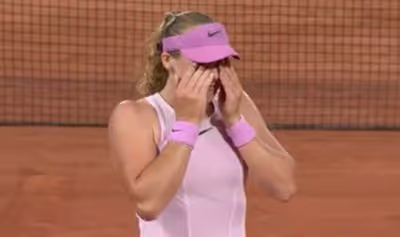
Andreeva raced through the first set, attacking with depth and pace to establish a 6-1 lead. Kostyuk, who arrived in Paris with an unbeaten clay record this season, struggled to find answers to Andreeva’s flat, penetrating groundstrokes. The Russian broke early in the second set, Kostyuk steadied to get back on serve and offered a brief lift, but Andreeva immediately reasserted control with a timely break to set up a serve for the match. The teenager held, celebrated emphatically and then broke down in tears as the moment sank in.
Tactical edge: why Andreeva prevailed
Andreeva’s blend of fearless shotmaking and court positioning removed the rhythm Kostyuk needed to exploit angles. The younger player moved through points with impressive timing, turning defence into offence and shortening rallies to neutralise Kostyuk’s momentum. Physically, Andreeva appeared fresher and more composed — a clear advantage in the latter stages of a two-week Grand Slam grind.
Head-to-head and recent form
This was the pair’s third encounter this season; Kostyuk had taken the previous two, most notably in Madrid. Paris offered a different context: heavier clay, the unique pressures of a Grand Slam semi-final and a player (Andreeva) who has visibly matured in big moments. Kostyuk’s earlier clay unbeaten streak made this result an upset on form lines, but not on the evidence produced in the match.
Off-court backdrop and the missing handshake
The semi-final carried an emotional overlay. Kostyuk has publicly revealed personal distress linked to strikes near family home areas in Ukraine during the tournament, and there was no handshake at the net after the match — a recurring sight in some Russia–Ukraine matchups.
The absence of a handshake and subsequent commentary from a senior tennis figure about whether nationality can weigh on a player’s mind underlined how geopolitical context can seep into sport at moments of maximum pressure.
What this means for both players
For Andreeva, the win cements her arrival as a genuine Grand Slam contender: she now has the mental proof she can close out big matches and handle intense atmospheres. That blend of aggression and composure will be dangerous in the final.
For Kostyuk, the loss ends an outstanding clay run and raises questions about how off-court stress and built-up expectations affect her capacity to convert favorable matchups. She remains a top-tier competitor, but this result highlights the thin margins that separate momentum from deflation at elite level.
Looking ahead
Andreeva heads into the final with clear upward trajectory — the challenge now is sustaining that intensity and managing the unique pressure of a maiden Slam title match. Kostyuk will need to regroup quickly, learning from what went wrong in Paris if she is to translate her clay form into consistent Grand Slam deep runs.
Sabalenka lets another golden Slam opportunity slip
Regardless of the next result, this semi-final underscored a generational shift and the growing depth on clay in women’s tennis.
 Express