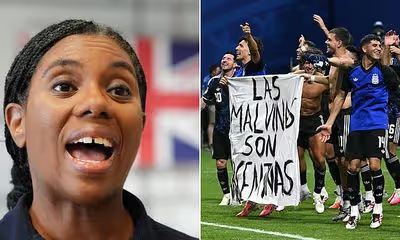
Breaking: Argentina players provoked a diplomatic storm after their World Cup semi-final win over England by unfurling a banner proclaiming "Las Malvinas son Argentinas." UK politicians, Falklands veterans and island representatives demanded a FIFA probe and possible sanctions ahead of Argentina's final with Spain, arguing the display violated tournament rules barring political messages and risked inflaming a long‑running sovereignty dispute.
Argentina banner after England semi-final triggers political backlash
Argentina's players celebrated their 2-1 semi-final victory over England in Atlanta by holding a white sheet that read "Las Malvinas son Argentinas." The image spread quickly, drawing swift condemnation from UK politicians, Falklands veterans and island authorities who called on FIFA to investigate the incident under tournament rules that forbid political slogans.
Who was involved on the pitch
Cristian Romero, Lisandro Martínez and Giovani Lo Celso were among those seen with the banner; Lionel Messi stood nearby during the celebration. Argentina now advances to the final against Spain, where the incident could cast a shadow over preparations and spotlight the tension between sporting spectacle and geopolitics.
Immediate responses from the UK and Falklands community
A Number 10 spokesperson described the stunt as unacceptable, saying, "The World Cup might not be ours, but the Falkland Islands definitely are." Opposition figures and veterans urged FIFA to impose sanctions and cited past disciplinary action in similar cases. The Falkland Islands government called the display "particularly insensitive" for many islanders.
FIFA discipline and precedent
Under tournament regulations — cited by critics as Article 34.3 — players are prohibited from displaying political messages before, during or after matches. FIFA's disciplinary committee has opened an assessment of match reports and will consider context before deciding on any measures.
What penalties are on the table
Disciplinary options range from fines to suspensions or, in extreme cases, disqualification. Historical precedent suggests fines are the likeliest outcome, but bans remain possible if FIFA deems the display a clear and deliberate breach. Analysts note that FIFA must balance enforcement of neutrality with the optics of punishing high-profile players during a World Cup final run.
Why this matters beyond sport
The banner revived a fraught sovereignty dispute that ended in war in 1982 and remains a deeply emotional issue in both the UK and Argentina. For the tournament, it tests FIFA's commitment to keeping political messaging out of matchday celebrations and raises questions about how international sport navigates national‑identity flashpoints.
Potential consequences for Argentina and the final
Even if sanctions are modest, the incident could strain diplomatic relations and sharply divide fan sentiment in the final. For Argentina's squad, disciplinary action or media scrutiny could be a distraction; for opponents and tournament organizers, it complicates efforts to keep the competition focused on football.
Context: history and public sentiment
The Falklands (Islas Malvinas) remain a sensitive subject: islanders overwhelmingly voted in a 2013 referendum to remain a British Overseas Territory, and the 1982 conflict left deep scars. Political leaders on both sides have long used the issue domestically, and displays like this tap into that history.
What happens next
FIFA's disciplinary committee will review reports and footage before announcing any formal measures. Officials and veterans will press for accountability; meanwhile attention will shift back to the final matchup between Argentina and Spain, where sporting stakes are now entangled with diplomatic fallout.
Bottom line
The banner was not just a post‑match provocation — it forced a governing body, national politicians and a global audience to confront where the line is between celebration and political assertion.
NYCFC courts Christian Pulisic, but Milan’s refusal and injury make an MLS move unlikely
How FIFA handles this will set a precedent for managing similar incidents at the sport's highest stage.
 Mail Online