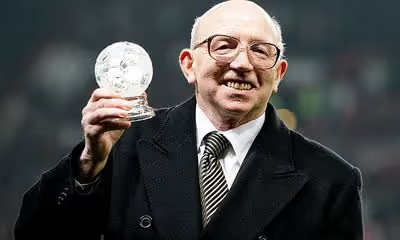
Nobby Stiles’ inquest concluded his severe dementia was compounded by chronic traumatic encephalopathy (CTE), with a neuropathologist linking the condition to repeated heading across his long playing career. His son’s testimony and campaign sharpen the spotlight on football’s legacy of head trauma, intensifying pressure on governing bodies to accelerate protections for former professionals and safeguard the next generation.
Coroner links Nobby Stiles’ dementia to CTE and repeated heading
An inquest has concluded that Nobby Stiles, a 1966 World Cup winner and former Manchester United midfielder, suffered severe dementia compounded by chronic traumatic encephalopathy (CTE).
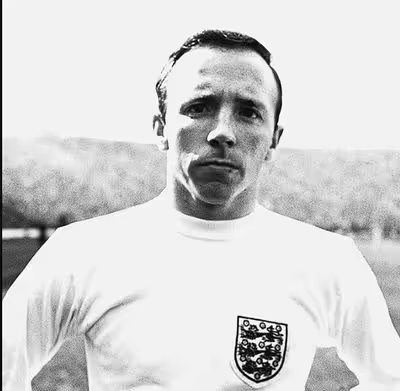
Neuropathology findings identified Alzheimer’s disease alongside CTE, with an expert witness stating repeated heading across Stiles’ career was the likely cause of the CTE diagnosis.
Key medical findings and testimony
Dr Daniel Du Plessis told the court he was “quite convinced” that the volume of headers Stiles performed caused the CTE observed in brain tissue samples. The pathology linked long-term neurodegeneration to cumulative head impacts rather than to a single traumatic event.
John Stiles, Nobby’s son, described his father’s progressive cognitive decline, noting memory loss and repetitive speech that worsened in later decades. He estimated his father headed the ball roughly 40 times a day during training across a 17-year career, a conservative tally of about 136,000 headers when taking match play into account.
Material differences in the ball and era
Testimony highlighted that match balls in Stiles’ era absorbed water and became substantially heavier, increasing impact force. While modern balls are less water-absorbent, studies cited in evidence suggest that even contemporary heading can impart substantial linear and rotational forces comparable to a heavy blow to the head.
Family campaigning and legal action
Stiles’ family have campaigned publicly for greater recognition and support for ex-players affected by neurodegenerative disease. John Stiles heads Football Families for Justice, a group pursuing claims alleging that football authorities failed in their duty of care by not adequately addressing the risks of repeated heading and concussive impacts.
Similar inquests and legal actions involving former professionals, including Gordon McQueen, have drawn comparable findings or suggestions that heading contributed to fatal brain injury. Those cases have intensified scrutiny of historical practices in training and match play.
Institutional response and scientific debate
The Football Association and other governing bodies have funded and cited research into neurodegenerative risk. A 2019 study co-funded by the FA and the Professional Footballers’ Association reported higher rates of neurodegenerative deaths among former players compared with general population controls. The FA has announced measures to phase out heading in youth football up to under-11s by 2026.
At the same time, football authorities have maintained that the causal chain between occasional concussion or heading and permanent brain damage is not definitively established for every case, creating a contested scientific and legal landscape that continues to evolve.
Why this matters: the implications for the game
The Stiles inquest crystallises a painful paradox for football: the sport’s most celebrated era produced icons whose later-life illnesses now challenge assumptions about long-term safety. For clubs, unions and governing bodies, the ruling increases moral and practical pressure to expand medical support, fund longitudinal research, and reassess training practices for professionals at all levels.
For current and future players, the decision reinforces momentum behind preventive measures already being trialled at youth levels. It also raises urgent questions about compensation, care pathways and how to reconcile the sport’s heritage with contemporary standards of player welfare.
What could happen next
Expect renewed legal activity and intensified advocacy from former players’ groups. Policymakers and football authorities may face accelerated calls to broaden youth protections, mandate monitoring protocols for head impacts, and commit to long-term funding for research into CTE and dementia in footballers. Clubs and player associations will be under pressure to clarify medical entitlements for retired professionals.
Context: a changing reckoning for contact sports
Football is not alone in confronting how repetitive head trauma affects athletes’ long-term brain health. The Stiles inquest adds to a wider, cross-sport narrative that has already driven rule changes, concussion protocols, and cultural shifts in contact sports worldwide. The debate now pivots from recognition toward action: what measures will be put in place to prevent further cases, and how will the sport care for those already affected?
Bottom line
The coroner’s finding connecting Nobby Stiles’ dementia to CTE tied to repeated heading strengthens the case for decisive policy change in football.
Rooney: Harry Kane's movement can unlock Argentina's Martínez and Romero in semi-final
It underscores the need for proactive player welfare measures, sustained research funding and clearer post-care support — a necessary evolution if the game is to protect both its current stars and its storied legacy.
 Mail Online