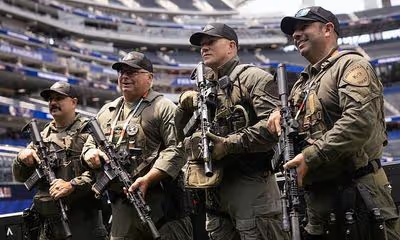
FBI and local authorities have labelled the England v Argentina World Cup semi-final the tournament's highest-risk match, prompting heightened security in Atlanta amid clashes between rival fans and concerns over politically charged chants referencing the Falklands, Maradona and Lionel Messi. Authorities are coordinating internationally to prevent violence while steering fan zones and stadium procedures to keep supporters apart and protect public safety.
Security alert ahead of England v Argentina World Cup semi-final
FBI briefings and local police have identified the England vs Argentina semi-final as the tournament's most volatile fixture, elevating it to a national-security priority.
Recent scuffles between supporters and intelligence suggesting hardened fan groups may travel to Atlanta have forced a rapid escalation of policing plans.
Immediate measures in Atlanta
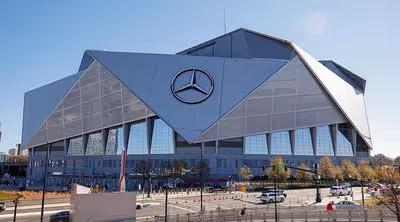
Stewards and law enforcement are increasing presence at Atlanta Stadium, which holds 68,239 spectators.Separate entry gates for England and Argentina fans will be used, though there is no internal segregation once inside the bowl.Authorities are encouraging designated bars to cater to one fan base or the other to reduce street-level flashpoints.Stewards have been instructed to confiscate flags depicting the Falklands in Argentine colours or labeling them as the Malvinas.
What has already happened and why it matters
Isolated clashes occurred in Miami after England’s win over Norway, raising alarm that incidents could escalate for a match steeped in history.The rivalry carries baggage from the 1982 Falklands War, Diego Maradona’s controversial “Hand of God” goal in 1986, and David Beckham’s 1998 red card — all events that intensify emotions beyond sport.This semi-final also carries added symbolism for Argentina with chants referencing Las Malvinas and Lionel Messi’s likely final World Cup.
Political and diplomatic dimensions
Argentina’s foreign ministry has publicly revived the Falklands claim this week, thrusting a diplomatic element into what is ordinarily a sporting encounter.The Argentine government is liaising with UK counterparts, the FBI and local US police — an unusual level of international coordination driven by the match’s high-profile nature.This convergence of politics and football increases the stakes for crowd management and public messaging.
Analysis: why this is more than a match
A high-tension fixture like England v Argentina tests modern event security: large, passionate diasporas, rapid international travel and social-media amplification can turn isolated incidents into national stories.The presence of politically charged slogans or displays makes policing decisions thornier, forcing authorities to balance free expression with public safety.Expecting large numbers of travelling fans, authorities must manage arrival hubs, fan zones and transport links as carefully as the stadium itself.
Potential outcomes and what to watch next
If security plans work, the match will proceed without major incident; failures could prompt post-match investigations and tighter measures for future tournaments.Watch for changes to fan-zone policies, additional confiscation rules, clearer messaging from both national teams, and continued diplomatic engagement.Ticketing and resale pressures may also affect crowd composition and the ability to monitor high-risk individuals.
How teams and figures are responding
Public commentary has reflected the charged atmosphere; a high-profile broadcaster defended using the Argentine term “Malvinas,” noting it is the name used in Argentina.Those remarks underline how language and narrative choices around the fixture can inflame passions or, alternatively, prompt dialogue about context and respect.
Final take
This England–Argentina semi-final is a reminder that elite international fixtures can carry geopolitical weight as well as sporting significance.
Scholes' 'Pussycats' Dig and Cole's Messi Claim Raise Stakes for England vs Argentina
Authorities face a complex task: deter violence, protect fans, and allow football to remain the focus.How well they achieve that will shape public perceptions of safety at major sporting events for years to come.
 Mail Online