France's World Cup bid ended in a 2-0 semi-final defeat to Spain, exposing tactical shortcomings under Didier Deschamps and uneven performances from key stars. Post-match player ratings were unusually harsh—Lucas Digne and Ousmane Dembélé were singled out—while Spain's composure and Dani Olmo's influence underscored a tactical superiority that now propels Spain into the final and leaves France to regroup for the third-place game.
Spain 2-0 France — Result and immediate fallout
Spain beat France 2-0 in the World Cup semi-final in Dallas, advancing to the final while leaving France to take stock ahead of the third-place match.
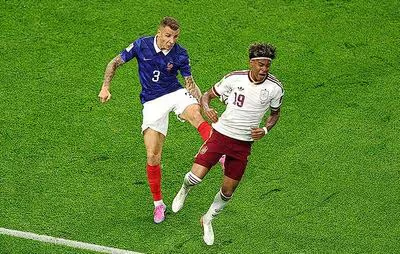
A Mikel Oyarzabal penalty opened the scoring after a defensive error, and Pedro Porro's strike wrapped up a performance that kept France's potent attack uncharacteristically subdued.
Key moments that decided the game
Lucas Digne's mishandling in the area led to the penalty after he failed to clear under pressure from Lamine Yamal. That opening goal forced France onto the back foot. Spain then controlled tempo and space, and Porro's finish punished France when they could not find a response.
Player performances and harsh post-match ratings
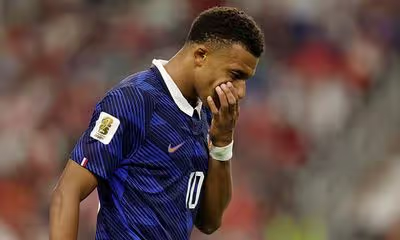
No French player emerged with a standout rating. Lucas Digne and Ousmane Dembélé drew the most severe criticism for costly mistakes and a lack of impact. Kylian Mbappé, often France's singular solution, looked isolated and labored to influence the game, earning a modest evaluation. Michael Olise also failed to reproduce the form that had lifted him earlier in the tournament.
Jules Koundé, Dayot Upamecano and Adrien Rabiot received middling marks; Rabiot showed energy and off-the-ball influence but was substituted at half-time after a booking limited his second-half role. On the Spanish side, Dani Olmo and Pedro Porro were standout figures, combining creativity and control; both were among the highest-rated performers.
Tactical read: why Spain kept France at bay
Spain's approach was disciplined and cohesive. They neutralized France’s wide threats, congested central lanes, and denied service to Mbappé. Spain’s midfield balance allowed them to sustain pressure without exposing gaps, while their full-backs provided width and precision in transition.
France, by contrast, lacked cohesion in attack and too often relied on individual moments rather than structured combinations. Substitution choices failed to shift momentum; the team never regained the sharpness that had produced 16 tournament goals earlier.
What this means for Deschamps and the French setup
The defeat crystallizes a tournament that started with title favourites but ended with more questions than answers. For Didier Deschamps, the loss highlights tactical inflexibility at crucial moments and the danger of trusting form over function when individual players are off their peak. France now face an inevitable period of evaluation: whether to tweak personnel, adjust tactical templates, or pursue a more significant reset.
Looking ahead: Spain in the final, France in regroup mode
Spain head to the final buoyed by control and several confident performers, with their coach’s game plan validated on a big stage. France must regroup quickly for the third-place match and the broader conversations that will follow.
How injuries to Rice, Saliba and Henderson are shaping the 2026 World Cup semi-finals
The squad has talent in abundance, but this result underlines that talent alone is not enough without tactical clarity and decisive coaching interventions.
 Mail Online