Alessandro Altobelli has publicly criticised Roberto Mancini’s return as Italy coach, praising his ability but calling the appointment “tainted” by Mancini’s abrupt August 2023 exit to Saudi Arabia and the opaque ties linking him with FIGC president Giovanni Malagò and technical director Claudio Ranieri. Altobelli says the method, not the merit, undermines trust with supporters at a sensitive moment for the Azzurri as they rebuild after recent setbacks.
Altobelli criticises Mancini’s reappointment
Alessandro Altobelli, a World Cup winner and veteran voice in Italian football, praised Roberto Mancini’s coaching credentials but refused to overlook how his first spell ended.
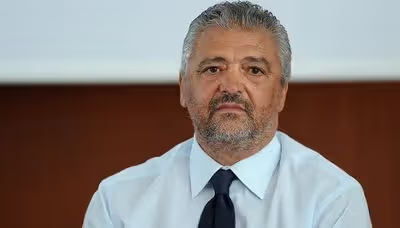
Altobelli called Mancini “exceptional” yet said there is “a stain” attached to the return because of the circumstances surrounding his departure.
Altobelli’s sharper lines targeted the optics rather than competence. He argued apologies now are “too late” and warned that the national team “belongs to everyone,” implying supporters and the wider Italian football community deserve clearer handling of high-profile appointments.
Timeline and context: Mancini’s exit to Saudi Arabia
Roberto Mancini resigned from the Italy job in August 2023 and took a role with Saudi Arabia’s national team shortly afterwards. His first stint with the Azzurri included memorable highs — notably winning UEFA Euro 2020 — but ended abruptly, leaving questions about loyalty and timing.
Those events frame why his return is sensitive. Reappointing a coach of Mancini’s stature brings experience and tactical acumen; the controversy is over process and message as much as footballing merit.
Why the method matters for the Azzurri
Altobelli singled out the connections between Mancini, FIGC president Giovanni Malagò and technical director Claudio Ranieri. His reference to Rome’s elite sporting circles — and the Aniene remark — was a thinly veiled critique of insider networks that shape decisions in Italian football.
This is important because national teams depend on public legitimacy as much as tactical clarity. Fans, federation stakeholders and players all respond to perceived fairness and transparency; when those erode, unity can fray. Altobelli framed his objections as process-driven: he credits the figures’ abilities but questions how they were installed.
Governance and perception
Italian football has long battled perceptions of opaque decision-making. Altobelli’s intervention exposes a governance fault line: bringing back a successful coach can deliver short-term stability, but if the process alienates supporters it risks creating a political burden Mancini will have to manage alongside on-field demands.
Implications for squad morale and public support
On the pitch, Mancini’s tactical acumen and leadership remain assets for a national team in transition. Off it, the federation must manage optics: reintegrating Mancini while reassuring fans and preserving credibility will be crucial.
Players typically prioritise preparation and results, but sustained public scepticism can seep into locker-room atmosphere. The immediate challenge is combining competence with clear communication to rebuild trust ahead of upcoming qualifiers and tournaments.
What to watch next
-Fan reaction at Mancini’s first games back — gestures of acceptance or lingering protests will signal public mood. -How Mancini addresses his exit and return publicly; candid acknowledgement could defuse some criticism. -Claudio Ranieri’s role as technical director — his relationship with players and selection approach will matter. -FIGC messaging under Giovanni Malagò; tangible transparency measures would help restore confidence.
Final take
Altobelli’s critique shifts the debate from “can Mancini coach Italy?” to “should he coach Italy under these conditions?” That distinction matters.
Mancini sets immediate targets and youth-led rebuild as he resumes Italy role
Competence can win matches, but credibility wins collective buy-in — and for the Azzurri at this juncture, both are indispensable.
 Football Italia