Salaries for top football managers have ballooned, driven by elite club budgets and international appointments. From Thomas Tuchel's England switch to Saudi and European heavyweights like Barcelona, Bayern and Newcastle, these 20 coaches command staggering pay packets reflecting trophy pedigree, commercial appeal and competitive pressure. This ranking reveals who benefits most from football's financial arms race — and why clubs are willing to pay top price for proven leadership.
Highest-paid football managers 2026: overview and context
The global market for managers is now as competitive as the transfer market. Clubs and federations pay premium wages for tactical acumen, trophy-winning credentials and the ability to manage superstar dressing rooms. These salaries are fingerprints of ambition: clubs aiming for Champions League glory, federations chasing major silverware, and Saudi projects demanding instant impact.
Managers 20–11: salaries, roles and what they mean
20. Thomas Tuchel — England — £5m per year
Tuchel arrives as England manager with a proven trophy-winning CV from Dortmund, PSG, Chelsea and Bayern. His appointment signals the FA’s intent to move from steady progress to genuine silverware pursuit. Expect tactical flexibility and heavy media scrutiny; delivering England’s first major title since 1966 would instantly validate this outlay.
19. Manuel Pellegrini — Real Betis — £5.2m per year
Pellegrini’s blend of pedigree and steady performance makes his Betis deal sensible. A Copa del Rey win and a deep European run justify the fee for a club aiming to cement regular European qualification. His experience provides stability and incremental growth rather than headline-grabbing revolution.
18. Eddie Howe — Newcastle United — £6.1m per year
Howe’s rise from Bournemouth to Newcastle encapsulates modern football’s risk-reward dynamic. He has delivered Champions League qualification and a League Cup, but recent regression in 2026 raises questions. His salary reflects both past success and the expectation he can steer the club back to consistent top-four finishes under heavy financial backing.
17. Jorge Jesus — Al-Nassr — £6.1m per year
Jesus exemplifies the Saudi pull: proven European and domestic success, now tasked with managing stars like Cristiano Ronaldo and Sadio Mané. At 71, his role is as much about man-management and structure as tactics. The appointment underscores Al-Nassr’s push for regional and continental dominance.
16. Vincent Kompany — Bayern Munich — £6.1m per year
Kompany’s rapid jump from Burnley to Bayern — including a significant compensation fee — shows how elite clubs prioritise long-term identity and modern coaching traits. Winning Bundesliga titles in his early seasons vindicated the gamble. He combines defensive coherence with progressive player development, a profile Bayern values for sustained dominance.
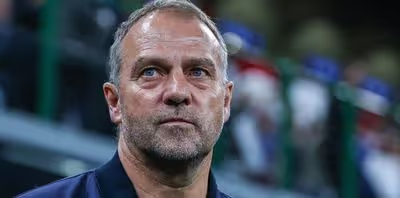
15. Hansi Flick — Barcelona — £6.5m per year
Flick’s tenure at Barcelona has married tactical pragmatism with attacking firepower from Lamine Yamal, Raphinha and Robert Lewandowski. After his continental treble at Bayern, Flick’s return to club excellence demonstrates his ability to reinvent teams. Barcelona’s willingness to pay reflects the expectation of sustained La Liga and Champions League contention.
14. Roberto De Zerbi — Tottenham Hotspur — £8m per year
De Zerbi took an almost-impossible assignment at Spurs and was rewarded handsomely. Known for progressive football and high-intensity transitions, he inherits a club in transition and must stabilise form and identity. His fee signals Tottenham’s desperation to avoid regression and to reassert themselves in the top tier of the Premier League.
13. Unai Emery — Aston Villa — £8m per year
Emery turned Villa’s fortunes quickly, delivering European football and deep continental runs. His four Europa League titles make him a specialist in knockout competitions, and Villa’s five-year gamble reflects belief in his sustained project-building. Expect Villa to prioritise Champions League qualification and incremental squad upgrades under his stewardship.
12. Gian Piero Gasperini — Roma — £8.1m per year
Gasperini’s reputation as an architect of attacking Serie A sides precedes him. His track record at Atalanta and a Europa League title justify a hefty wage. Roma want creative intensity and Champions League returns; Gasperini delivers a clear tactical identity, though his high-press style requires precise squad composition.
11. Massimiliano Allegri — AC Milan — £8.1m per year
Allegri’s experience and trophy-laden résumé keep him in demand despite questions about long-term dynamism. Milan’s re-hire is a bet on pragmatic stability rather than revolution. If Milan fail to challenge for Serie A or progress in Europe, patience may wear thin — but his salary buys experience at the highest level.
Why these wages matter
These salaries are not merely compensation — they are strategic investments. Clubs and federations use high pay to attract proven leaders, placate star players, and signal immediate intent to fans and sponsors. The payoff is measured in trophies, revenue growth, and long-term sporting direction. For managers, high salaries bring pressure: underperformance risks short tenures despite lucrative contracts.
What to watch next
Keep an eye on performance in domestic leagues and European competitions. Managers on this list face clear benchmarks: league positions, cup runs, and European progression.
Success will justify heavy spending and shape future hiring markets; failure will prompt questions about whether financial muscle alone can buy sustained footballing excellence.
 Givemesport