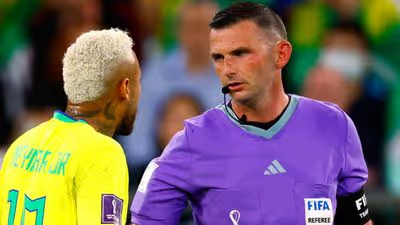
FIFA will pay World Cup referees a record $100,000 each at the 2026 tournament, a payday that could eclipse a Premier League official’s full season earnings; Michael Oliver and Anthony Taylor are among the match officials selected, with Jarred Gillett assigned to VAR duties. Expanded VAR powers and strict new time-wasting rules mean referees will operate under unprecedented scrutiny across the 48-team, 104-match event.
Referees set for record pay at 2026 World Cup as rule overhaul raises stakes
FIFA has put referees at the centre of the 2026 World Cup narrative by offering a $100,000 flat fee for tournament involvement — a figure that eclipses past tournaments and, for many officials, rivals or exceeds domestic-season earnings. With pay rising alongside a raft of new in-game regulations and broader VAR authority, the global refereeing corps will face both a lucrative reward and intensified pressure in a 48-team, 104-match competition.
What referees will earn and why it matters
$100,000 per appointed referee represents a significant uplift — roughly double what officials received at the 2014 World Cup. Additional match-stage bonuses are available, increasing substantially for retained officials who progress into the knockout rounds and culminating in the largest payout for those chosen for the final on 19 July. For established Premier League referees, such pay can top an otherwise full season’s income, turning a five-week assignment into a career-defining payday.
Premier League officials, VAR specialists named
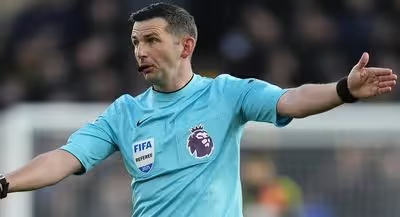
High-profile English referees Michael Oliver and Anthony Taylor are among those selected for the tournament, adding international prestige to seasons already packed with Premier League, FA Cup and Champions League duties. Australian Jarred Gillett — long integrated into the Premier League refereeing pool in a specialist role — will attend principally for VAR responsibilities. Their presence signals FIFA’s intent to field experienced officials in both on-field and video-review roles.
Rule changes designed to clamp down on time-wasting and dissent
FIFA has introduced stricter time-wasting enforcement that changes the flow and management of matches. Substitutes will be required to exit the pitch within ten seconds. Players leaving for treatment must remain off for a full minute.
Throw-ins and goal kicks will be governed by a five-second countdown, and covering the mouth during exchanges with match officials may lead to immediate dismissal. These measures aim to speed play and reduce time-wasting but place greater onus on referees to enforce marginal calls consistently.
VAR’s expanded remit increases intervention likelihood
Video Assistant Referee powers have been extended. VAR can now overturn incorrectly awarded corners, review red cards issued as a consequence of a second yellow, and disallow goals for attacking fouls even before the ball crosses the line. Those changes close frequent complaint lines from fans and managers, but they also multiply touchpoints for intervention, amplifying scrutiny on both VAR teams and on-field officials.
Scale and logistics: the largest refereeing operation in World Cup history
The tournament will deploy 52 referees, 88 assistant referees and 30 VAR officials across 104 matches — the most extensive officiating infrastructure seen at a World Cup. That scale reflects the expanded 48-team format and the complexity of synchronising on-field and video decisions across multiple host cities and time zones.
What this means for the game and for referees
The financial incentives demonstrate FIFA’s effort to professionalise and reward elite officiating, helping to attract top talent and encourage retention. Simultaneously, broader VAR authority and tighter time-wasting rules increase the likelihood of more frequent interventions and higher-profile referee decision-making moments. For officials, the result is a rarer combination of financial reward and reputational risk.
Outlook: consistency, training and the aftermath
Expect intense scrutiny on consistency early in the tournament as referees apply new rules under global attention. The event will function as a case study for whether stricter time-management protocols and expanded VAR yield clearer outcomes or simply shift controversy into different formats.
Juventus move for Aston Villa fan favourite after Liverpool shut down transfer deal
Successful implementation could raise the refereeing bar worldwide; inconsistency or high-profile errors will fuel debate about technology, protocols and the limits of officiating in the modern game.
 Givemesport