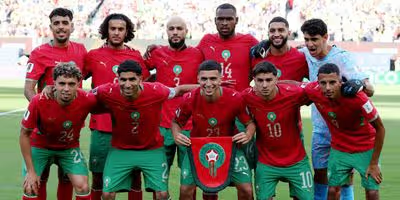
Morocco’s 26-man roster reveals a striking diaspora footprint: only seven players were born inside Morocco while the rest hail from Spain, France, the Netherlands, Belgium and Canada. That mix — led by names like Achraf Hakimi, Sofyan Amrabat and Yassine Bounou — highlights the Atlas Lions’ reliance on overseas development and means coach Mohamed Ouahbi could conceivably start an XI made entirely of foreign-born talent.
Morocco squad dominated by foreign-born talent
Morocco’s current 26-man squad in the World Cup contains just seven players born inside the country, with six from Spain, six from France, three from the Netherlands, three from Belgium and one from Canada.
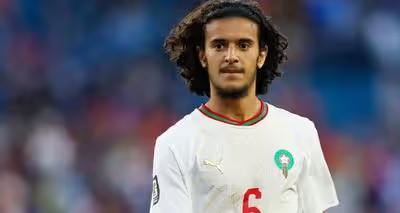
The distribution underlines a national team built largely on the European-born diaspora, blending players developed in top European academies and leagues.
Key numbers at a glance
7 — Born in Morocco
6 — Born in Spain
6 — Born in France
3 — Born in the Netherlands
3 — Born in Belgium
1 — Born in Canada
Country-by-country breakdown
Spain (6)
Spain produces some of Morocco’s most influential figures: captain Achraf Hakimi (Madrid-born), Brahim Díaz (switching allegiance after an initial Spain cap), Munir Mohamedi (born in Melilla), Chadi Riad, Ayoube Amaimouni and Ismael Saibari. These players bring experience from La Liga and other top European competitions.
France (6)
France’s contribution includes centre-backs Issa Diop and Redouane Halhal, midfield prospects like Ayyoub Bouaddi and Samir El Mourabet, Gessime Yassine and Roma’s Neil El Aynaoui. Many of these players have risen through Ligue 1 pathways, reinforcing Morocco’s defensive and midfield depth.
Netherlands (3)
The Netherlands has supplied Sofyan Amrabat, Noussair Mazraoui and Anass Salah-Eddine — players schooled in Eredivisie academies who combine tactical discipline with physical readiness for top-level European football.
Belgium (3)
Belgium-born players include Zakaria El Ouahdi (Genk), Bilal El Khannouss and Chemsdine Talbi. Their Belgian training backgrounds emphasize technical sharpness and adaptability.
Canada (1)
Yassine Bounou (Bono) is the sole Canada-born player in the squad. A veteran goalkeeper with international experience, his path — born in Montreal, raised in Casablanca — encapsulates the transnational stories behind many Moroccan internationals.
Morocco (7)
The domestically born contingent includes Ahmed Reda Tagnaouti, Marwane Saadane, Youssef Belammari, Azzedine Ounahi, Ayoub El Kaabi, Soufiane Rahimi and Amine Sbaï. They preserve a direct link to Morocco’s domestic game and local development structures.
Why the diaspora-heavy profile matters
This selection reflects football’s globalization and Morocco’s success in tapping talent across borders. Players developed in Europe arrive with tactical education, high-level competition experience and club exposure that the national team leverages. That has tangible upside: improved technical standards, tactical flexibility and a deeper talent pool than most African nations.
At the same time, the prominence of foreign-born players raises questions about the balance between domestic development and scouting abroad. Sustaining long-term success requires continued investment in Moroccan academies so homegrown prospects can complement the diaspora influx.
Tactical implications for coach Mohamed Ouahbi
A squad assembled across Europe gives Ouahbi multiple formation options. Fullback-firepower from Hakimi, midfield muscle from Amrabat and ball-playing defenders like Diop and Mazraoui allow transitions between 3-4-3, 4-3-3 or hybrid shapes. Goalkeeping depth with Bounou and Tagnaouti stabilizes selection issues.
The challenge for the coach is integrating diverse club philosophies into a coherent national identity: forging tactical clarity, rhythm and defensive coordination among players accustomed to different systems.
What to watch next
Selection battles will focus on blending European-honed stars with Morocco-born core players. Watch how Ouahbi manages minutes, role definitions and chemistry in friendlies and qualifiers. The ongoing emergence of young dual-nationals means the pool will remain competitive — and the team’s identity will keep evolving.
Barcelona poised to sign Karim Adeyemi in pragmatic €20-€40m deal
Morocco’s model shows how a national team can leverage a global diaspora to punch above its weight. The next step is turning that blended talent into sustained, predictable performances on the biggest stages.
 Givemesport