
Donald Trump denied discussing FIFA's proposed $20bn World Cup investment vehicle with Gianni Infantino as a political and commercial storm engulfs football: UEFA, CONCACAF and the AFC have voiced outright opposition, senior FIFA staff have resigned, and a contentious September 19 vote could decide whether the governing body opens the game to outside equity — a move that would reshape governance, revenue control and trust in FIFA leadership.
FIFA's $20bn investment plan and why it matters
FIFA has advanced plans to create a roughly $20 billion subsidiary to manage the World Cup and other competitions, offering up to 20% equity to outside investors. The proposal is pitched as a revenue-maximising move to professionalise commercial management of FIFA competitions.
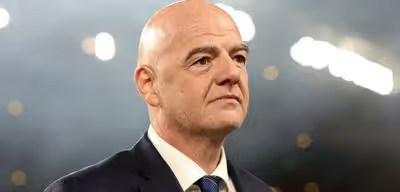
A reported link between the investment vehicle and a fund founded by Joshua Kushner has intensified scrutiny. That connection, combined with high-profile meetings between FIFA president Gianni Infantino and Donald Trump, has turned a commercial restructuring into a political headache.
What the proposal would change
Selling a minority stake in a vehicle that controls tournament rights changes who benefits from the World Cup’s future value. Even a 20% external stake shifts incentives, brings private investors into core football assets and complicates governance structures designed to protect member association control.
For federations that prioritise sovereignty and equitable revenue distribution, the plan raises immediate red flags about transparency, influence and long-term control.
Union and confederation backlash: boycott threats escalate
UEFA has publicly warned its national teams will refuse to participate in FIFA competitions if the plans proceed. CONCACAF and the Asian Football Confederation have expressed strong opposition, with several major football nations aligning behind boycott sentiment.
Those threats are not symbolic. A coordinated boycott would undermine the credibility and competitive integrity of FIFA tournaments and significantly reduce their commercial value — the very outcome investors ostensibly want to avoid.
Why European federations are particularly hostile
European associations have a stronger commercial base and more to lose from ceding influence over global rights and governance. For UEFA members, a partially privatised World Cup vehicle threatens bargaining power, revenue sharing frameworks and the political architecture that has long insulated national federations from private equity pressures.
Internal turmoil at FIFA
The proposal’s fallout has translated into internal dissent. Senior FIFA staff have resigned in protest, and reports of internal accusations that Infantino misled colleagues have surfaced. That institutional distrust compounds external opposition and raises questions about decision-making processes at FIFA.
A leadership perceived as opaque or cavalier on governance risks deeper damage than any immediate commercial misstep; trust is a harder asset to rebuild than revenue.
What resignations and dissent signal
When senior advisers and executives depart over a single project, it signals a governance crisis, not merely a policy disagreement. Member associations will judge FIFA’s proposal not just on economics but on the leadership’s competence and motives.
The September 19 vote: an inflection point
FIFA has scheduled a vote on the investment vehicle for September 19. With UEFA and two other major confederations opposed, the plan faces a substantial risk of rejection or an embarrassing outcome that would expose deep divisions.
If the vote succeeds despite wide opposition, FIFA will inherit a fractured membership and ongoing reputational damage. If it fails, the organisation will have to retreat and recalibrate its commercial strategy amid weakened authority.
Possible immediate consequences
A failed vote could stall FIFA’s commercial ambitions for years, embolden reform-minded associations and trigger a broader governance review. A narrow approval would likely invite legal and political challenges from disgruntled member associations.
2030 World Cup expansion push
Alongside the investment row, FIFA is reportedly considering expanding the World Cup from 48 to 64 teams for 2030 and appointing an independent agency to study the change. The 2030 edition — co-hosted by Morocco, Portugal and Spain, with commemorative matches in South America — is already set to be a centenary event.
Expanding to 64 teams would reshape qualification dynamics, increase costs and extend the tournament window, while diluting competitive balance for some stakeholders.
Why expansion adds complexity now
Proposals to enlarge the tournament intersect with the investment debate: more teams and longer events change the product investors are buying into and complicate revenue-sharing models. Combined, these initiatives amplify the scale and stakes of FIFA's commercial overhaul.
What this means for the future of the World Cup and FIFA governance
The current crisis is as much about trust and institutional stewardship as it is about money. Opening the World Cup to outside investors can unlock capital and professional expertise, but it also requires ironclad governance safeguards, transparent conflict-of-interest rules and buy-in from member associations.
Without those safeguards, any commercial gain risks being offset by political fragmentation and long-term reputational harm.
Key questions moving forward
Will FIFA produce clear governance protections that reassure confederations and national associations? Can Infantino restore internal confidence and secure a mandate that represents the membership’s interests? Will proposed investor links survive political scrutiny without stricter disclosure and conflict policies?
Next steps and likely scenarios
Short term: all eyes are on the September 19 vote. Expect intensified lobbying, formal proposals to amend governance protections and public statements from federations pushing for guarantees.
Medium term: a rejected plan would force FIFA back to the drawing board, likely delaying any privatisation attempt and prompting governance reforms. An approved plan without consensus would leave FIFA managing a prolonged internal crisis and legal risks.
Long term: the episode will set a precedent about how football balances commercialisation with member control. The outcome will determine whether FIFA can modernise revenue streams without sacrificing the institutional trust that underpins the sport.
FIFA's $20B commercial spin-off collapses after clubs and European federations threaten boycott
Conclusion: This is a leadership test as much as a commercial pitch. FIFA can still design an investor model that benefits the game, but only if it rebuilds trust, clarifies governance, and secures genuine member buy-in before selling the future of the World Cup.
 Givemesport