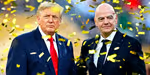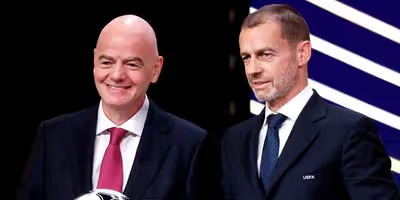
Breaking: FIFA president Gianni Infantino’s proposal to create FIFA Forward Enterprise — selling tradable minority stakes in the World Cup and raising $4.2bn with JPMorgan — has provoked UEFA’s outright rejection and a threat that European associations, including England, may boycott the 2030 World Cup, escalating a governance and commercial standoff that could reshape international football.
FIFA Forward Enterprise: the proposal at the centre of the storm
Gianni Infantino wants to transform the FIFA World Cup into a commercial vehicle by creating FIFA Forward Enterprise (FFE), an entity that would issue tradable minority equity stakes tied to FIFA’s 211 member associations.
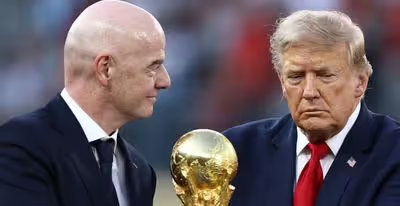
The proposal envisages raising roughly $4.2bn from private investors, with global bank JPMorgan named as a financial partner. Infantino set a response deadline of September 19 for national associations — a move that forced a rapid and combative reaction from UEFA.
UEFA pushes back — and signals a potential boycott
UEFA convened an emergency meeting of its 55 national associations and categorically rejected the FFE plan. Officials declared the World Cup “cannot be treated as an investment product” and said national associations would not participate in FIFA competitions under the proposed structure.
That stance carries immediate risk: if UEFA follows through, European teams — including co-host nations and heavyweights such as England, Spain and Portugal — could be absent from the 2030 World Cup, undermining the tournament’s sporting legitimacy.
England’s position and the broader European unity
The English FA publicly aligned with UEFA’s collective position, saying it stands “shoulder to shoulder” with European colleagues in opposing the plan. England’s support underscores a rare moment of continental cohesion against FIFA management, signaling national federations are prioritising governance and football stewardship over short-term commercial gain.
Why this matters — beyond boardroom finance
Turning World Cup participation into tradable equity alters the fundamental relationship between national associations and the global competition. UEFA’s reaction reflects fears that investor-driven imperatives could skew sporting priorities, erode member control, and set a precedent for commodifying international representation. A mass European boycott would not only diminish on-field quality but also fracture broadcasting, sponsorship and host-nation planning — consequences that reverberate far beyond finance.
Historical context: boycotts and absences at past World Cups
National associations have missed World Cup tournaments before for political, financial or principled reasons. Early editions saw several home nations and South American teams decline participation, and during the 20th century political events led to other absences or disqualifications. Those precedents show boycotts can be symbolic and consequential — depriving tournaments of marquee teams and highlighting governance disputes.
What happens next — timelines and likely scenarios
With a hard deadline imposed by FIFA, the next fortnight will test whether the threat of a European withdrawal is a negotiating posture or a binding course of action. Possible outcomes range from a negotiated compromise limiting commercialisation, to a showdown that forces reconsideration of commercial partners and tournament structure. If UEFA and national associations maintain unity, Infantino may face the choice of revising the proposal or risking a deeply compromised World Cup in 2030.
Longer-term implications for global football
This is not just a quarrel over money; it’s a clash over who controls the game’s flagship event. How it resolves will influence governance norms, investor appetite for sports assets, and the balance of power between confederations and FIFA.
From World Cup goals to Weibo fame: 'Ha Bao' makes Erling Haaland an Asian star
For fans and players, the key question is whether commercial innovation can coexist with the integrity and representative ethos that underpin international football.
 Givemesport