The Carolina Panthers walked away from Bank of America Stadium with a 32-26 victory over the Detroit Lions on Sunday, a game defined by a dominant receiving performance, a steady passing display and a physical ground game that helped tilt the late stages in Carolina's favor.
Tetairoa McMillan's night: volume, explosiveness and near-records
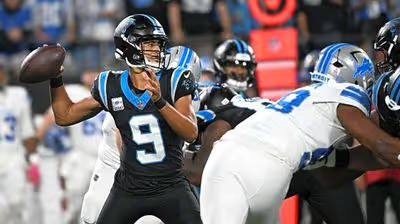
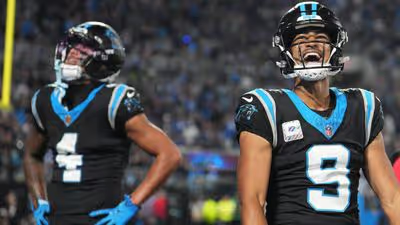
Tetairoa McMillan emerged as the focal point of the Panthers' attack, hauling in 14 passes for 192 yards and accounting for 43.1% of Carolina’s net offense. His reception total and yardage paced the home team and kept Detroit's secondary on its heels all night.
McMillan nearly rewrote franchise history: he finished one catch and nine receiving yards shy of tying two longtime Panthers records, underscoring how central he was to the game plan. The crowd repeatedly chanted "MVP!" for the Panthers' quarterback during key moments, a scene McMillan said he tried to ignore as he “stayed zoned into the action” in the fourth quarter, per ESPN.
Bryce Young orchestrates sustained drives
Bryce Young managed the offense with steadiness, completing 29 of 41 pass attempts and engineering six scoring drives that kept Carolina ahead for much of the second half. Young's connection with his top target forced the Lions into difficult defensive assignments, opening lanes for the running game and conversion chances on crucial downs.
Carolina made the most of those opportunities: Bryce Young threw two touchdown passes to Tetairoa McMillan, and Chuba Hubbard rushed for 122 yards and two touchdowns in the Panthers' 32-26 victory.
Chuba Hubbard's ground work and defensive resistance
Chuba Hubbard provided balance, finishing with 122 rushing yards on 20 carries and adding a pair of rushing scores. One of those scores — a 2-yard run late in the third quarter — pushed Carolina’s lead to 29-19 and swung momentum firmly in the Panthers’ favor.
On the defensive side, Carolina held Detroit to two touchdowns, a limiting performance that complemented the offense's timely execution and allowed the Panthers to withstand a late push. Facing a Lions team that entered as a 3.5-point favorite, Carolina’s unit bent but did not break when Detroit threatened.
How the game unfolded and what stood out
From the opening quarters, the Panthers mixed intermediate passing with downhill running to keep Detroit off balance. McMillan’s volume catches often came on intermediate routes that stretched the Lions' linebackers and safety help, while Hubbard’s interior work cleaned up yards after contact and kept drives alive.
Young’s ability to sustain drives — coupled with Carolina’s willingness to be aggressive on fourth down — created repeated third-and-short or fourth-and-manageable situations that the offense converted into points. Special teams and the defense supplemented those efforts by forcing manageable field positions, letting the Panthers control the clock in the fourth quarter.
Individually, McMillan’s combination of targets, separation and yards-after-catch made him the standout, while Hubbard’s toughness on the ground gave Carolina a finishing edge. Young’s composure and volume passing kept the chains moving and repeatedly put the Panthers in field-goal or touchdown range.
Context and immediate takeaway
The game highlighted Carolina's blueprint when its top playmakers are clicking: feed the hot receiver, lean on a capable running back to finish drives and be unafraid to go for it on fourth down when necessary. McMillan's receiving output and Hubbard’s work in the trenches provided a template for how the Panthers can manufacture offense even against favored opponents.
Defensively, limiting Detroit to two touchdowns was a necessary complement to the offense's production. Together, those elements combined for a win that showcased depth in playmaking and situational execution across phases.