The New England Patriots fell 30-24 in Soldier Field, a loss defined less by injuries than by missed opportunities and defensive breakdowns. New England battled injuries along the offensive line and elsewhere on the roster, but that misfortune did not fairly describe what went wrong in Thursday’s game — the Patriots repeatedly left points and momentum on the field and were unable to contain Chicago’s explosive plays.
Defensive lapses and tackling problems
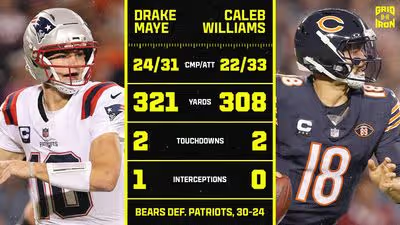
New England’s defense showed a recurring vulnerability to the big play, most starkly in the first half when Luther Burden III finished with four catches for 130 yards and a touchdown. Burden’s 24-yard score with 14 seconds remaining before halftime swung momentum and helped the Bears carry a lead into the break.
Several Bears scoring plays illustrated a Patriots unit that struggled to wrap up ball carriers. Tight end Colton Loveland’s 14-yard touchdown came after he slipped past four Patriots defenders en route to the end zone, a sequence that underscored breakdowns in pursuit angles and open-field tackling.
Head coach Mike Vrabel didn’t parse the loss into a single cause; he pointed squarely at fundamentals. “Tackling wasn’t good enough,” he said during the postgame press conference, as reported by Yahoo! News. That admission captured the theme of the evening: sloppiness on defense kept surfacing at critical moments.
Those lapses allowed Chicago to sustain drives that New England could not answer consistently. After a stretch of four scoreless possessions for both teams, the Bears regained possession at their own 9-yard line with 6:22 remaining and produced the decisive late field-goal drive.
Offense flashed but failed to close
On the other side of the ball, New England produced bursts that showed what the offense can be when timing and execution align. After a kickoff sequence late in the first half, New England scored to trim the deficit before halftime.
New England answered early in the second half with a scoring drive that illustrated the offense’s ability to strike quickly when protections held and route concepts matched up favorably. Those moments kept the game within reach, but they were scattered amid missed chances.
Bleacher Report’s box score summary noted that the Patriots and Bears went scoreless across multiple possessions in the middle of the game, a stretch in which New England failed to seize control despite having opportunities to do so. Wasted opportunities on both sides of the ball, as the club’s postgame assessments put it, ultimately proved costly.
New England’s defense did make a noteworthy play late when defensive tackle Christian Barmore registered a sack that knocked the Bears back to the Patriots' 40-yard line with 1:39 remaining, but Chicago held on for a 30-24 victory.
What the game suggests the Patriots must fix
The loss highlighted three discrete areas New England will need to address: tackling fundamentals, limiting explosive completions, and converting offensive momentum into sustained scoring. Coach Vrabel’s blunt assessment about tackling frames the problem as correctable detail work rather than inevitability; the team’s inability to wrap up and prevent yards after contact repeatedly turned manageable plays into game-altering gains.
New England also showed it can generate quick-strike scoring — the 80-yard touchdown and the late first-half drive are proof — but consistency remains an issue. The offense produced highlight plays but not a reliable sequence of possessions that could flip control to the Patriots for extended stretches. With injuries adding to the list of hurdles, those efficiency and execution problems loom larger.
Against an opponent that manufactured timely explosive plays and converted in clutch moments, the Patriots left too much to overcome. The blueprint for improvement is straightforward on paper: tighten tackling, eliminate breakdowns that allow single plays to create separation, and convert red-zone and drive-ending opportunities into points. How quickly New England addresses those fundamentals will determine whether this defeat becomes a corrective moment or the start of a trend.