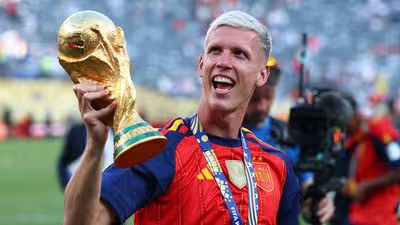
Dani Olmo has rejected Argentina assistant coach Roberto Ayala’s apology after Ayala struck him following Spain’s World Cup final victory, calling the explanation — that it was a pushed reaction to a comment — a lie and insisting true accountability is required from an opposing coach who crossed the line postmatch.
Olmo Refuses Ayala’s Apology After World Cup Final Confrontation
Roberto Ayala, Argentina’s assistant coach, has apologized for striking Dani Olmo after Spain’s World Cup final win, calling it “more of a push” and blaming a reaction to a comment. Olmo publicly rejected that account, accusing Ayala of lying and saying an apology that justifies the act is not genuine.
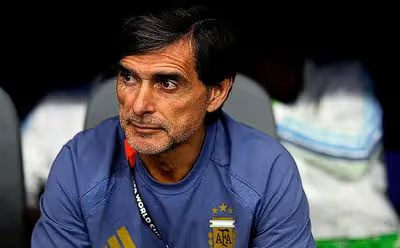
The Barcelona midfielder said he did not provoke Ayala and demanded full ownership of the incident.
The incident
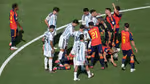
The clash unfolded immediately after the final whistle in a tense postmatch scene. Ayala intervened amid heated exchanges between players, initially positioning himself as a peacemaker, but then made contact with Olmo’s throat area. Ayala later described the act as a push rather than a punch, saying it was a response to something Olmo allegedly said. Olmo has strongly denied making any comment that would justify such conduct.
Context: a fractious postmatch and Argentina’s reaction
The episode was one of several ugly moments involving Argentina players in the aftermath of defeat. Midfielder Leandro Paredes was involved in two separate confrontations — grabbing Eric García by the throat and pulling Gavi to the ground — incidents that added to the chaotic scenes. Paredes has since acknowledged Spain as deserving winners, but the cluster of confrontations has left a bitter postscript to an intensely fought final.
Olmo’s standing in Spain’s World Cup run
Olmo’s role in Spain’s campaign was more about influence than headline-grabbing statistics. The 26-year-old provided the between-the-lines movement and technical balance that allowed Rodri and Fabián Ruiz to control midfield phases, and he often facilitated the team’s high-possession approach. Withdrawn after 75 minutes of the final, Olmo watched as Ferran Torres ultimately netted the extra-time winner, capping a tournament in which Spain conceded just once and emphasized collective function over individual flash.
Why this matters beyond one regrettable moment
An opposing coach physically striking a player after a match is a breach of professional norms that undermines the spirit of elite competition. Ayala’s attempt to minimize the contact by calling it a push and citing provocation weakens the credibility of his apology in the eyes of the abused player and observers. Olmo’s insistence on accountability isn’t just personal grievance; it’s a call for clearer standards when staff, not just players, overstep.
What the confrontation reveals about international tensions
The altercations exposed the raw emotions that can follow a high-stakes final and highlighted how quickly decorum can collapse. For Spain, the victory was confirmation of Luis de la Fuente’s collective approach — a squad first, star players complementing a robust system. For Argentina, the postmatch behavior will invite scrutiny of discipline and composure after heartbreak, and of how staff intervene in volatile moments.
Looking ahead: repercussions and restorative steps
Immediate disciplinary outcomes remain in the hands of tournament authorities and national federations, but the reputational damage is already tangible. Argentina will need to demonstrate that its staff and players can manage emotions without resorting to physicality. For Spain and Olmo, the episode will likely harden a sense of solidarity around the squad’s achievement and reinforce demands for proper apologies and accountability.
Final analysis
The incident should be treated as more than a heated blip: it’s an integrity issue at international level. Olmo’s refusal to accept a justification-based apology is a principled stance that calls for clearer standards and consequences.
On the pitch, Spain’s triumph remains rooted in collective discipline and preparation; off it, both federations have work to do to repair relations and reassert professional conduct.
 Si
Si