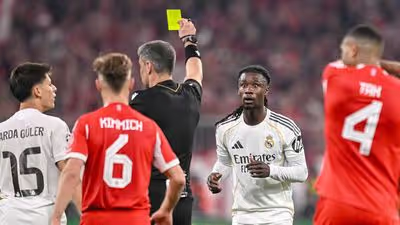
Eduardo Camavinga’s late red card at Bayern Munich — for scooping up the ball after a foul on Harry Kane — overturned Real Madrid’s Champions League tie and left the midfielder reportedly “inconsolable.” The dismissal has sparked fury from teammates and intensified debate over Camavinga’s role and long-term future at the Bernabéu.
Camavinga sent off as Real Madrid exit Champions League
Real Madrid were eliminated from the Champions League after a dramatic second-leg loss at Bayern Munich that hinged on Eduardo Camavinga’s controversial red card. Madrid led 3–2 on the night but were level 4–4 on aggregate when the senior decision arrived late in the second half.
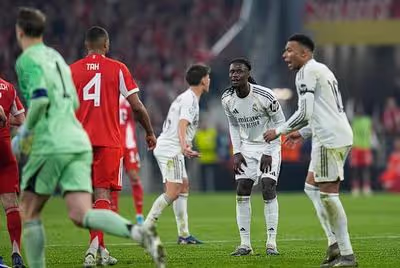
Camavinga had already been booked for hauling down Jamal Musiala on 78 minutes. Eight minutes later, after a foul on Harry Kane, he appeared to delay the restart by picking the ball up and earned a second yellow, which became a red.
The dismissal felt unusually harsh in context — the act of collecting the ball to disrupt play is rarely punished with a send-off at that level — and prompted immediate protests from teammates while leaving Madrid short-handed for the closing minutes. The sequence has been portrayed as both a technical enforcement and an avoidable, costly lapse.
On-field fallout and team reaction
Jude Bellingham, Arda Güler and Dani Carvajal were among those openly aggrieved at full-time, confronting officials and voicing the dressing-room frustration. The sense of injustice among players and supporters intensified because the second booking stemmed from a minor, relatively common tactic to slow a restart rather than a cynical or violent act.
For Madrid the timing could not have been worse: the game was balanced and the club’s Champions League hopes hinged on fine margins. The red card not only changed the match mechanics but also reshaped the narrative around the midfielder involved.
Camavinga’s reaction and public apology
Camavinga did not face the mixed zone after the game and was reported to be distraught in the dressing room, visibly upset over his role in the elimination. He later posted a frank apology: “I take responsibility for my part. I want to apologize to the team and to the Madridistas. Thank you for your support, Hala Madrid.”
Former Madrid player Álvaro Arbeloa publicly offered backing, noting the player’s pain and the importance of the competition to both club and individual. That support is important, but it does not remove the spotlight from Camavinga’s on-field decision-making at a decisive moment.
Why this matters for Camavinga’s career at the Bernabéu
Camavinga arrived from Rennes in 2021 amid elite expectations and has frequently been deployed as a versatile utility option — covering midfield roles and even left back. He has fluctuated between promise and inconsistency: his peak performance came in a recent Champions League final when he excelled in the absence of a teammate, yet this season errors and uneven displays have invited social-media ridicule and tactical doubts.
The red card crystallizes a broader issue: Madrid need reliable discipline and composure in knockout fixtures. Camavinga’s temperament has at times undermined his technical gifts, and that calculus will factor into squad planning.
Reports suggest the club may consider selling to fund reinforcements, and clubs such as Chelsea, Manchester United and Paris Saint-Germain have been linked as possible destinations. Camavinga remains contracted until 2029, so any move would be significant and deliberate.
What the club must weigh
For Real Madrid, the question is whether Camavinga is a long-term starter, a high-value squad option, or an asset to monetize. His versatility is valuable, but elite teams demand consistency in moments that decide trophies. The apology and teammates’ support buy him time; what will matter more is his response on the pitch over the closing weeks of the season.
Looking ahead: finish strong or fresh start?
The immediate task for Camavinga is pragmatic: finish the campaign by producing steady, mature performances that remind the club and potential suitors why he was once one of Europe’s most sought-after youngsters.
Longer term, a fresh start might be the most constructive outcome for both player and club — a reset could unlock his best years without the pressure-cooker expectations at the Bernabéu.
"Real Madrid and Barcelona have nothing to complain about with the referees"
Whatever follows, the Bayern incident is a clear inflection point. It exposed a split between raw talent and match-temperament that Madrid must resolve quickly if they are to remain contenders at the highest level.
 Si
Si