
Breaking: Weston McKennie arrives in peak form ahead of the USMNT’s June 12 World Cup opener at SoFi Stadium, his career-best club season at Juventus bolstering a veteran-laden squad under Mauricio Pochettino. Two high-profile friendlies against Senegal and Germany will be decisive final tests before the United States hosts the 2026 FIFA World Cup.
McKennie’s form injects momentum into USMNT as World Cup looms
27-year-old Weston McKennie has emerged as one of the U.S. men’s national team’s clearest advantages heading into the 2026 FIFA World Cup. Dominant minutes and a career-best 15 goal contributions for Juventus this season mean he arrives in stronger physical and attacking form than at any previous international tournament. That matters: form translates to confidence, and confidence fuels leadership on a squad expected to shoulder heavy home expectations.
Why club performance matters
Success at Juventus — consistent starts in Serie A and influence in key moments — gives McKennie tactical sharpness and match fitness that few U.S. midfielders can match. His ability to shuttle between box-to-box duties and high-energy pressing adds a dual threat: he can destabilize opponents through both recovery runs and late attacking entries.
Experience stacked in Pochettino’s roster
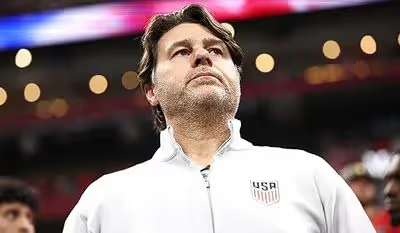
This edition of the USMNT will be noticeably more seasoned than 2022. Manager Mauricio Pochettino is likely to call upon at least a dozen players who played in Qatar, providing a blend of institutional memory and tactical maturity. McKennie, a starter in every 2022 World Cup match for the U.S., frames that continuity as a competitive edge — lessons learned in elimination can be applied now, not rehearsed under pressure for the first time.
Why experience changes tournament dynamics
A squad with multiple World Cup veterans is less susceptible to first-game nerves and can better absorb the tactical swings of knockout-style competition. That doesn’t guarantee results, but it improves the team’s ability to manage games, react to setbacks, and execute game plans under duress.
Pochettino’s high press suits McKennie’s strengths
Pochettino’s trademark intensity — a compact, high-pressing structure that forces turnovers and quick transitions — dovetails with McKennie’s energetic style. He thrives when the team demands aggressive ball-winning and verticality from midfield. Expect McKennie to be deployed where his stamina and aggression create both defensive cover and late-arriving offensive danger.
Tactical implications for the starting XI
Under Pochettino, midfield roles become more specialized: a designated trigger for press, a pivot to recycle possession, and runners to exploit transitions. McKennie’s versatility gives Pochettino tactical flexibility: he can press higher as a disruptor, or sit deeper when the match calls for structure. That versatility could be decisive in group-stage matchups and beyond.
Tune-up friendlies offer urgent evaluation: Senegal and Germany
Charlotte and Chicago will host two final rehearsals before the World Cup: Senegal and Germany. These fixtures are more than marketing — they are live diagnostics of fitness, chemistry, and tactical clarity. For McKennie and his teammates, these games will confirm who can sustain Pochettino’s demands for 90 minutes and who still needs refinement.
What to watch in the friendlies
Look for pressing intensity, midfield rotation effectiveness, and how quickly the team toggles from recovery defense to purposeful offense. Individual metrics — distance covered, recoveries, progressive passes — won’t be the headlines, but patterns will: is the USMNT compact, does it concede dangerous transitions, and can it convert high press into consistent goal threats?
What this means for the U.S. at the 2026 World Cup
McKennie’s peak form and the squad’s added experience raise realistic expectations beyond a simple round-of-16 ceiling. On home soil, the U.S. can aim for deeper progression if Pochettino’s system clicks and injuries hold off. However, depth and consistent execution across 90-plus minutes remain the principal risks.
Bottom line
Weston McKennie gives the USMNT a power outlet they’ve rarely had at full throttle: physicality, pressing aptitude, and late-goal instincts.
With a veteran core and a coach favoring aggressive, modern tactics, the U.S. arrives in 2026 as a more dangerous and tactically coherent team — provided the tune-up matches sharpen rather than expose lingering weaknesses.
 Si
Si