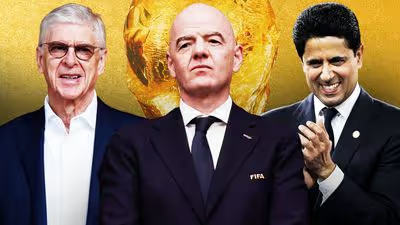
Gianni Infantino faces a full-blown governance crisis after proposals to sell part of the World Cup sparked resignations, a threatened UEFA boycott and calls for leadership change; with the 2027 election looming, several high-profile figures — from Alexander Ceferin to Nasser Al-Khelaifi and Arsène Wenger — are being floated as possible alternatives as global football institutions weigh their next move.
FIFA presidency at a crossroads as Infantino confronts backlash
Gianni Infantino’s leadership is under intense scrutiny after plans to bring private investment into the World Cup provoked rare and coordinated opposition from national associations. The controversy has already prompted senior departures, public rebukes and talk of boycotts from Europe’s 55 UEFA members that would affect women’s and youth World Cups.
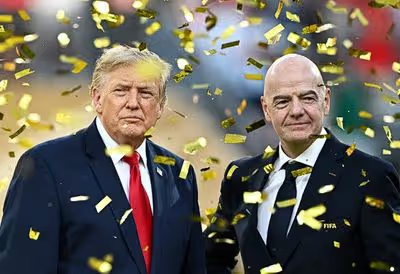
If Infantino does not resign, his position will be tested politically ahead of the 2027 election — despite rule changes that could allow him an unprecedented fourth term through 2031.
What sparked the crisis
FIFA’s proposal to create a commercially driven sister company and invite private capital for World Cup rights triggered the backlash. The plan was seen by many federations as a fundamental change to how the sport is governed and monetised, prompting swift pushback across confederations. A senior FIFA adviser has resigned amid the upheaval, adding to the perception that Infantino’s strategy has fractured internal consensus.
Why this matters for global football
The dispute goes beyond personality: it raises governance, accountability and commercialisation questions at football’s highest level. A UEFA boycott would represent an unprecedented political strike and could damage FIFA’s product, sponsorship value and the sport’s global calendar. How FIFA resolves this will influence relations among confederations and set precedents for private investment in major events.
Potential successors: who could realistically challenge Infantino?
Infantino has run unopposed in 2019 and 2023; a competitive contest would mark a significant shift in FIFA politics. Below are the names most commonly discussed and what each represents.
Alexander Ceferin — UEFA’s steady counterweight
As UEFA president, Ceferin is the most obvious contender. He has repeatedly clashed with FIFA over governance and competition issues and has publicly distanced himself from some FIFA decisions. Ceferin has a strong European power base and the experience of leading football through complex disputes. But he appears content in his UEFA role and may only step forward if convinced no suitable alternative emerges — a reluctant steward rather than an ambitious challenger.
Nasser Al-Khelaifi — the influential outsider
PSG president and head of the European Football Clubs organisation, Al-Khelaifi combines club-level clout and Gulf-state backing. His profile would appeal to stakeholders seeking commercial savvy and established ties to elite clubs. Public statements insist he has no current intention to run, but his name surfaces because he bridges modern football’s commercial and institutional spheres.
Arsène Wenger — the football technocrat
Wenger’s work at FIFA as Chief of Global Football Development gives him credibility on the sport side rather than pure politics. He offers a reform-minded, football-first voice and would likely focus on development, competition integrity and technical standards. Wenger lacks broad governing experience at the confederation level, however, which could limit his appeal among voting federations.
Victor Montagliani — CONCACAF continuity with an ambition
As CONCACAF president, Montagliani was previously mentioned as a possible candidate. He has regional support in North America and a practical understanding of FIFA’s stakeholder map. His term in CONCACAF is up for renewal, which could either provide a springboard to challenge or constrain his ability to run.
Salman bin Ibrahim Al Khalifa — AFC influence in the mix
The AFC president and a FIFA Council senior vice-president, Salman represents Asia’s institutional voice. He combines experience within FIFA structures and regional influence, making him a viable consensus candidate if federations seek continuity with a different temperament.
Analysis: likely scenarios and their implications
Infantino retains power: Expect a period of strained relations with UEFA and potential legal or calendar fallout; commercial plans may proceed but with reputational cost. Infantino steps down or is replaced before 2027: That would trigger an intense scramble for alliances, with confederations jockeying to influence FIFA’s commercial and governance direction.
A negotiated compromise: FIFA could scale back or reconfigure private-investment plans to regain consensus, preserving Infantino’s leadership in exchange for governance safeguards.
What to watch next
Whether UEFA follows through on a boycott and how other confederations respond will determine momentum. Resignations or further defections within FIFA would increase pressure dramatically. Any formal candidacy filings ahead of 2027 will reveal which blocs are prepared to back change and who can build a global coalition.
Conclusion
This is more than a leadership row: it’s a test of how world football balances commercial ambition with collective governance.
MLS excuses Messi and De Paul from All-Star after World Cup final, signaling shift to player welfare
The coming months will show whether FIFA can reconcile competing visions or if a new era of leadership will be demanded by the game’s major stakeholders.
 The Sun