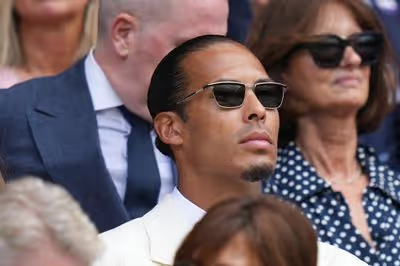
Virgil van Dijk sat in a star-studded Royal Box as British wildcard Arthur Fery tangled with Alexander Zverev and umpire Marijana Veljovic over an apparent net-cord serve, spotlighting Centre Court drama and a technological gap at Wimbledon that leaves some disputed serves to human hearing alone.
Van Dijk, celebrities and Centre Court drama at Wimbledon
Liverpool's star Virgil van Dijk, wearing a white suit, joined wife Rike in the Royal Box on Centre Court alongside Louis Theroux, Benedict Cumberbatch and Anna Wintour as Arthur Fery faced Alexander Zverev.

The high-profile attendance underlined Wimbledon’s perennial mix of elite sport and celebrity sparkle — but it was the on-court confrontation, not the VIP line-up, that grabbed headlines.
Fery challenges umpire after suspected net-cord on Zverev serve
During the first set, Fery emphatically challenged an undetected net-cord on a Zverev serve, telling umpire Marijana Veljovic that “everyone heard that.” Veljovic maintained she did not hear the clip; Zverev also said he hadn’t heard it. The row added heat to a tight opener that finished 7-6 in Zverev’s favour, the German dominating the tiebreak 7-0.
Why the incident matters: a tech blind spot at Wimbledon
Wimbledon uses Hawk-Eye for line calls but has no system to determine whether a serve grazes the net. That leaves umpires reliant on audible cues at times — an imperfect solution on a noisy Centre Court. The episode exposed a clear operational gap: modern line-calling tech hasn’t yet solved every contentious element of play.
Practical barriers to fixing it
Installing reliable net-touch detection poses logistical and acoustic challenges. Microphones can be unreliable; sensors on the net change its properties and installation could affect play. Still, the incident will reignite conversations about whether incremental technology — sensors, better audio capture or supplementary replay tools — should be trialled for serve-net calls.
Match implications: Fery’s fire versus Zverev’s composure
Fery’s protest spoke to competitive intensity rather than gamesmanship. The British wildcard’s willingness to confront an umpire on Centre Court plays well with home support, but it didn’t translate into the scoreboard. Zverev’s 7-0 tiebreak signalled clinical experience under pressure, suggesting the German can absorb provocation and stay focused — a key advantage in the latter stages of a Slam.
Context: Van Dijk’s summer and the celebrity narrative
Van Dijk’s presence carries crossover appeal: fresh off a World Cup campaign with the Netherlands — eliminated on penalties by Morocco — the Liverpool captain added sporting gravitas to SW19’s glamour. Celebrities in the Royal Box amplify interest, but they seldom influence on-court adjudication; this time, the dispute reminded viewers that the core drama remains the players and the officials.
What to watch next
Keep an eye on how match officials manage crowd-fuelled disputes and whether tournament organisers publicly address the net-touch limitation. For the players, Zverev’s tiebreak dominance is a warning sign for any opponent; Fery will need to temper emotion with execution if he’s to overturn higher-ranked rivals.
Iraola to face media at Kirkby as Liverpool prepare for US pre-season tour
For Wimbledon, the episode is a prompt to evaluate whether selective technological updates could reduce avoidable controversies.
 The Sun