


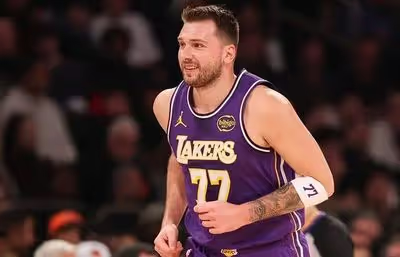
Luka Doncic has joined an investor group led by former Mavericks executive Donnie Nelson to purchase Vanoli Cremona and relocate the club to Rome for the 2026-27 season, aiming to restore top‑flight basketball to the Italian capital and position the team as a contender for the planned NBA Europe competition.
Luka Doncic buys Vanoli Cremona, moves club to Rome
Luka Doncic is part of an investor group that completed the purchase of Vanoli Cremona and will relocate the club to Rome for the 2026-27 season. The move aims to revive professional basketball in the Italian capital and build a team capable of competing on a continental stage as plans for NBA Europe take shape.
What happened
Doncic, linked to the investor group led by former Mavericks executive Donnie Nelson, announced the acquisition and relocation. Vanoli Cremona — a long-standing member of Italy’s top domestic league — will be rebranded and based in Rome ahead of the 2026-27 campaign. Ownership described the transaction as both a nod to Cremona’s history and a commitment to raising standards for basketball in Rome and across Italy.
Why it matters
This is more than a high‑profile investment — it’s strategic positioning. Doncic’s profile and European pedigree can accelerate growth for a Rome franchise, attracting sponsorship, fans and talent. For Italian basketball, a well‑funded Rome club could shift the domestic balance of power and give the country a stronger foothold as continental competitions evolve.
NBA Europe context
Organizers continue developing NBA Europe, a proposed transcontinental competition that could launch in the coming years. Early plans envision a multi‑team format with several permanent locations across major European cities; Rome has been flagged as a priority. Rules and timelines are not finalized, but having an investor group already committed to Rome strengthens the city’s case for inclusion.
Dončić’s ties to Europe and the NBA
Doncic’s roots in European basketball — he rose through Real Madrid’s academy before becoming an NBA superstar — make this investment a natural extension of his brand. His involvement bridges elite NBA status and European development, offering a player‑investor dynamic that can foster youth pathways and scouting pipelines back to top professional leagues.
Practical challenges and next steps
Relocating a club entails arena plans, regulatory approvals, and community engagement. Ownership says it will honor Vanoli’s history while investing in facilities, coaching and roster upgrades.
Separate from that, final governance for any NBA Europe participation — including ownership rules and player eligibility — remains to be determined. The real test will be execution: building a competitive roster, securing a suitable venue in Rome and integrating into Italy’s basketball calendar.
What this could mean for the sport
If handled intelligently, this project could catalyze a renaissance for professional basketball in Rome and strengthen Europe’s competitive architecture. Doncic’s involvement gives the venture instant credibility and global visibility. For fans and stakeholders, the key questions are speed of delivery, sustainable investment, and whether the club can become a genuine European contender rather than a vanity project.
Bottom line
This is a bold, logical move that blends star power with long‑term ambition.
Victor Wembanyama rookie card sells for record $5.11 million
With Doncic and experienced operators behind it, a Rome franchise has a real shot at becoming a focal point for elite European basketball — provided the ownership group navigates the practical hurdles and the broader NBA Europe framework evolves constructively.
 Yahoo! News


