


Down 2-0 in the NBA Finals, the San Antonio Spurs must find ways to re-open Victor Wembanyama’s offense against New York’s suffocating help defense. Game 3 is urgent: targeted pick-and-roll adjustments — empty-side rolls, lower screen depth, and smarter spacing — are the clearest levers to get Wembanyama downhill, reduce turnovers and prevent this series from slipping into a near-impossible 3-0 deficit.
Spurs face an urgent pick-and-roll problem with Victor Wembanyama
The Spurs have reached the NBA Finals on the strength of Victor Wembanyama’s transformational two-way impact, yet he’s been constrained so far. Wembanyama is averaging 27.5 points through the first two games, but efficiency and playmaking have dipped: 48% on 2s, 27% on 3s, and a troubling 10 turnovers to four assists.
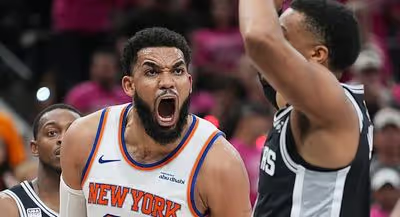
Those figures matter most now — the Finals are unforgiving, and the Spurs must unlock their primary lever or risk falling into a 3-0 hole.
Why the Knicks’ defense has worked
New York has matched physicality with smart help rotations. Opponents have hit Wembanyama with high tags and early nail help, pushing him off scoring spots and forcing Spurs ball-handlers into uncomfortable reads. The tactic mutes his downhill gravity and turns potential clean finishes into contested touches or turnovers. The result: the Spurs’ roll game is less productive than earlier playoff rounds.
Roll efficiency shows a clear gap
Across the playoffs, the Spurs’ success when Wembanyama rolls has varied dramatically:
- vs. Blazers: 28 picks, 1.15 points per possession, 10.7% tag rate
- vs. Timberwolves: 83 picks, 0.99 PPP, 27.7% tag rate
- vs. Thunder: 135 picks, 1.02 PPP, 37.8% tag rate
- vs. Knicks (first two games): 50 picks, 0.93 PPP, 34% tag rate
A 0.93 PPP on roll actions is simply insufficient against a Knicks team that's winning the margin of error battle. The Spurs must lift that number to reestablish rhythm and spacing.
Screen distance and production
Wembanyama’s on-ball screens are coming significantly farther from the rim in these Finals — about 27.7 feet versus his 24.7-foot regular-season average. Production by screen location through two games:
- 0–22.9 feet: 9 picks, 1.25 PPP
- 23–26.9 feet: 16 picks, 0.64 PPP
- 27+ feet: 31 picks, 0.79 PPP
Those splits make the case for resetting where Wembanyama sets screens: closer looks yield better payoff.
Concrete adjustments for Game 3
The Spurs don’t need schematic reinvention — they need smarter leverage of what already works.
1) Force empty-side rolls more often
When Wembanyama is the screener on the empty side, roll or pop actions should lean toward the vacated wing. Rolling to the empty side creates clearer lob lanes, easier reads for ball-handlers and better transition balance. The Spurs have run the empty-side variant only nine times in this series and converted it once; that ratio should flip.
2) Mix in lower on-ball screens
Bringing screens closer (inside the 23-foot window) forces the Knicks into quicker help decisions and increases high-value finishes. The data shows higher PPP on nearer screens. Lower screens also make high-tag tactics more awkward for defenders.
3) Use flat spacing and off-ball occupation
Flat alignment — both wings empty, corners occupied, a player in the dunker spot — reduces the effectiveness of low-man peel and high tags. Delayed rolls or pops from Wembanyama against that spacing have produced clean drives and lobs in earlier rounds. Off-ball screens (pindowns, flares) can occupy the weakside and discourage aggressive nail help.
4) Leverage Spain and Double-Drag selectively
V actions are valuable, but Spain sets and Double Drag alignments can punish the Knicks’ chosen help reads by creating mismatches and freeing Wembanyama’s path. A clean example: using Wembanyama as the first screener, stashing a shooter in the corner and letting the roll zone toward the open wing produced an easy lob. These actions don’t need to be run repeatedly but should be used to change the Knicks’ defensive calculus.
5) Adjust ball-handling and reads
With turnover issues from some ball-handlers, the Spurs should prioritize dribble angles that move toward the empty side and quicker, simpler reads. Keeping Stephon Castle away from extreme nail-contact routes and letting him attack with space raises the chance of clean entry passes or defended but productive shots.
What this means for the series
If the Spurs can re-establish Wembanyama as a consistent roller and downhill threat, their spacing and secondary offense will improve immediately, making the Knicks defend more horizontally and less aggressively. That shift would open kick-outs, reduce turnovers and restore the Spurs’ identity as an offense that can punish help defense.
Luka Dončić invests in Italian team that's relocating to Rome, could represent city in NBA Europe
If those adjustments fail to produce, New York will keep leaning into physicality and help — and the Spurs risk a short series. Game 3 is not just another contest; it’s the tactical crossroads where the Spurs must prove Wembanyama can affect the board as often as he anchors it defensively.
 Yahoo! News


