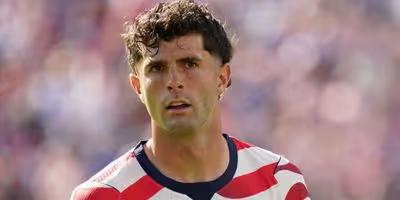
Jermaine Jones has leapt to Christian Pulisic’s defence after a wave of criticism following the USMNT’s 4-1 World Cup defeat to Belgium, arguing Pulisic remains the country’s premier player despite injury and scrutiny from former stars. Jones highlights poor performances across the lineup and warns against single-player scapegoating, as Tim Howard offers a more sympathetic read of Pulisic’s post-match demeanour.
Jermaine Jones backs Christian Pulisic amid heavy criticism
Jermaine Jones has publicly defended Christian Pulisic after high-profile criticism of the USMNT captain following the 4-1 loss to Belgium in the World Cup last 16.
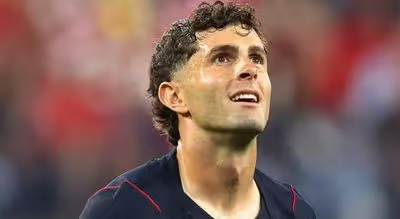
Jones called Pulisic “the greatest American player of all time” and urged former internationals to stop singling him out for blame, pointing to subpar performances from several teammates in the same game.
What Jones said — blunt defence and a reminder of context
Jones did not mince words: he praised Pulisic’s career and warned critics to “be careful throwing stones when you live in a glass house.” He highlighted defensive and goalkeeping errors from teammates — naming Sergino Dest, Tim Ream and Matt Freese — to argue bad days are collective, not just the failings of one star.
Why the criticism landed
Carli Lloyd and Landon Donovan were among former players who publicly criticised Pulisic’s performance and reactions after the loss. Much of the backlash focused on Pulisic’s visible frustration, his substitution after 59 minutes because of injury, and comments that some perceived as nonchalant in the immediate aftermath of elimination.
Tim Howard’s take: empathy over condemnation
Tim Howard offered a more sympathetic interpretation, suggesting Pulisic’s guarded interview style may be a defense mechanism while dealing with injury and disappointment. Howard reiterated that being the team’s highest-profile player brings disproportionate praise and blame — a burden Pulisic will continue to carry.
Pulisic’s injury and its effect on perception
Pulisic sustained a significant leg injury in the Belgium defeat, including a fracture and bone bruise, which forced his early exit. That medical reality reframes some criticism: playing through pain or leaving the field with an injury complicates expectations about performance and leadership in high-stakes matches.
How injury changes the narrative
An injured star alters both tactical output and emotional signals. Fans and pundits often expect visible fight from marquee players; when injury compromises that, it can be misread as indifference rather than physical limitation. Jones’ defence channels that nuance back into the discussion.
What this means for the USMNT and Pulisic
The exchange between past stars and current defenders underlines a recurring American soccer tension: who bears responsibility in failure, and how should leaders be judged? Pulisic remains the headline talent for club and country, but the team’s World Cup exit exposes structural and collective shortcomings that won't be solved by targeting one player.
Implications for leadership and team culture
Public debates like this can sharpen accountability — or deepen divisions. Productive follow-ups would focus on coaching, defensive lapses, goalkeeper errors and squad resilience rather than personal vilification. For Pulisic personally, managing recovery, public communications and on-field returns will be crucial to restoring the narrative.
Looking ahead
Expectation management will be central as Pulisic rehabs and prepares for the next cycle. The USMNT must address tactical weaknesses exposed in the Belgium match while protecting its key players through clearer communication about injuries and roles.
Spain's defensive discipline makes them clear favorites against Belgium
Jones’ intervention is a reminder that single-player scapegoating rarely explains team failures; the rebuild, tactical tweaks and leadership evolution will determine future results.
 Givemesport