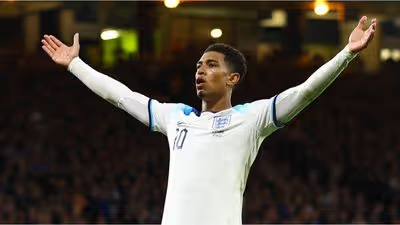
From Pelé's unassailable 17-year-old landmark to 2026's breakthrough talents, this ranked list profiles the 20 youngest players to score at the FIFA World Cup. It traces historic firsts, modern prodigies and what these early milestones reveal about talent identification, national team trust and the careers that followed — and still could — for names like Pelé, Messi, Mbappé, Gavi and rising stars in Qatar and beyond.
Youngest World Cup goalscorers — quick verdict
Scoring at the World Cup as a teenager is both a rare achievement and a reliable signal of exceptional potential. This countdown highlights players who seized the sport’s biggest stage early — some launching legendary careers, others leaving a brilliant, singular mark in tournament history.
The full top 20 (rank, player, country, age, World Cup)
20 Ronald Gonzalez, Costa Rica — 19y 319d, Italy 1990
19 Mazzola, Brazil — 19y 288d, Sweden 1958
18 Moussa Wague, Senegal — 19y 263d, Russia 2018
17 Edmund Conen, Germany — 19y 198d, Italy 1934
16 Kylian Mbappé, France — 19y 183d, Russia 2018
15 Tostão, Brazil — 19y 171d, England 1966
14 Jude Bellingham, England — 19y 145d, Qatar 2022
13 Martin Hoffmann, East Germany — 19y 88d, Germany 1974
12 Divock Origi, Belgium — 19y 65d, Brazil 2014
11 Julian Green, USA — 19y 25d, Brazil 2014
Top 10 — the youth who changed games
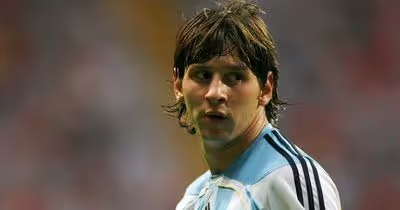
10 Lionel Messi, Argentina — 18y 357d, Germany 2006 Messi’s first World Cup goal arrived just minutes into his tournament debut, announcing a talent that would define a generation. Early composure and clinical finishing foreshadowed a career of elite consistency on the biggest stages.
9 Lamine Yamal, Spain — 18y 343d, Qatar 2026
Yamal’s goal in the 2026 group stage confirmed the hype surrounding the Barcelona prodigy. A two-week margin younger than Messi’s debut underlines Spain’s latest attacking jewel and the ongoing cycle of youth-led evolution in international squads.
8 Kerim Alajbegovic, Bosnia and Herzegovina — 18y 276d, Qatar 2026
Scoring in Bosnia’s landmark 3-1 win over hosts Qatar, Alajbegovic not only netted early in his international career but helped propel his nation into the knockout phase for the first time — a goal with both personal and historic national significance.
7 Dmitri Sychev, Russia — 18y 231d, Korea/Japan 2002
Sychev’s early World Cup impact — youngest Russian representative and youngest Russian goalscorer — provided a rare bright spot for a team eliminated at the group stage. His mix of creativity and directness made him an immediate fan favourite.
6 Nicolae Kovacs, Romania — 18y 197d, Uruguay 1930
An inaugural World Cup moment: Kovacs scored in 1930 and briefly held the tournament’s youngest-scorer record. His achievement is a reminder how early World Cups produced enduring statistical footnotes.
5 Michael Owen, England — 18y 190d, France 1998
Owen’s burst onto the World Cup scene epitomised raw pace and instinct. His goal against Romania validated Liverpool form and set the template for England’s faith in young forwards capable of changing matches off the bench.
4 Ibrahim Mbaye, Senegal — 18y 143d, Qatar 2026
Mbaye struck shortly after coming on against France, becoming both Senegal and Africa’s youngest World Cup scorer. His goal represents the continent’s continuing production of edge-of-field attackers who combine club pedigree with international promise.
3 Gavi, Spain — 18y 110d, Qatar 2026
As a non-striker on this list, Gavi’s inclusion underscores the modern value of midfielders who score. His opener against Costa Rica rewarded manager Luis Enrique’s trust and highlighted Spain’s capacity to develop complete, goal-contributing midfield talents.
2 Manuel Rosas, Mexico — 18y 93d, Uruguay 1930
Rosas’ 1930 campaign was a study in firsts: the tournament’s first penalty scored and a youthful presence that set early World Cup narratives. His dual legacy — own-goal and historic penalty — encapsulates football’s capacity for rapid twists of fate.
1 Pelé, Brazil — 17y 239d, Sweden 1958
Pelé’s quarterfinal strike as a 17-year-old remains the benchmark. His subsequent hat-trick in the semi-final and brace in the final transformed a teenage prodigy into a global icon and established Pelé as the gold standard for youthful World Cup impact.
Why these moments matter
Teenage goals at the World Cup do more than pad highlight reels. They test a player’s temperament under maximum pressure and often accelerate club and national team trajectories. For nations, a young scorer can shift tactical plans, galvanize squads and energise fanbases. For players, early World Cup success frequently — though not always — correlates with faster career elevation, bigger transfers and sustained international roles.
Patterns and takeaways for teams and scouts
Scouts and national coaches value composure, timing and decision-making as much as raw talent. Many names on this list combined technical quality with situational intelligence: finishing from limited chances, adapting to senior teammates, and delivering decisive moments. Modern youth development is producing more technically ready teenagers than ever, but national team managers still choose carefully when to fast-track young talents.
What comes next — cautious projection
For contemporary names like Lamine Yamal, Gavi and the 2026 breakout talents, the challenge is converting early bursts into durable excellence. Consistency, injury management and club environments will determine whether these youngsters sit alongside Pelé and Messi in long-term legacies or remain celebrated World Cup moments. National teams, meanwhile, must balance youth integration with tactical stability to maximise these players’ impact.
Bottom line
The list of youngest World Cup goalscorers is a catalogue of promise — some of it fulfilled, some of it frozen in time. Each entry tells a story about talent meeting opportunity.
England must unlock stubborn Panama as minnows seek first World Cup goal
The World Cup remains the ultimate proving ground where teenagers can either announce themselves permanently or leave a singular, unforgettable imprint.
 Givemesport